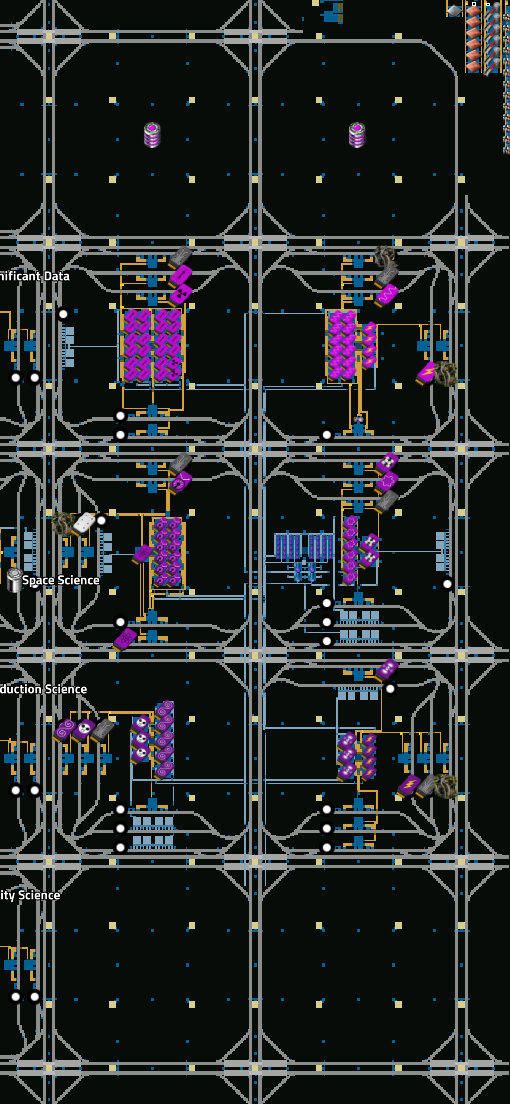
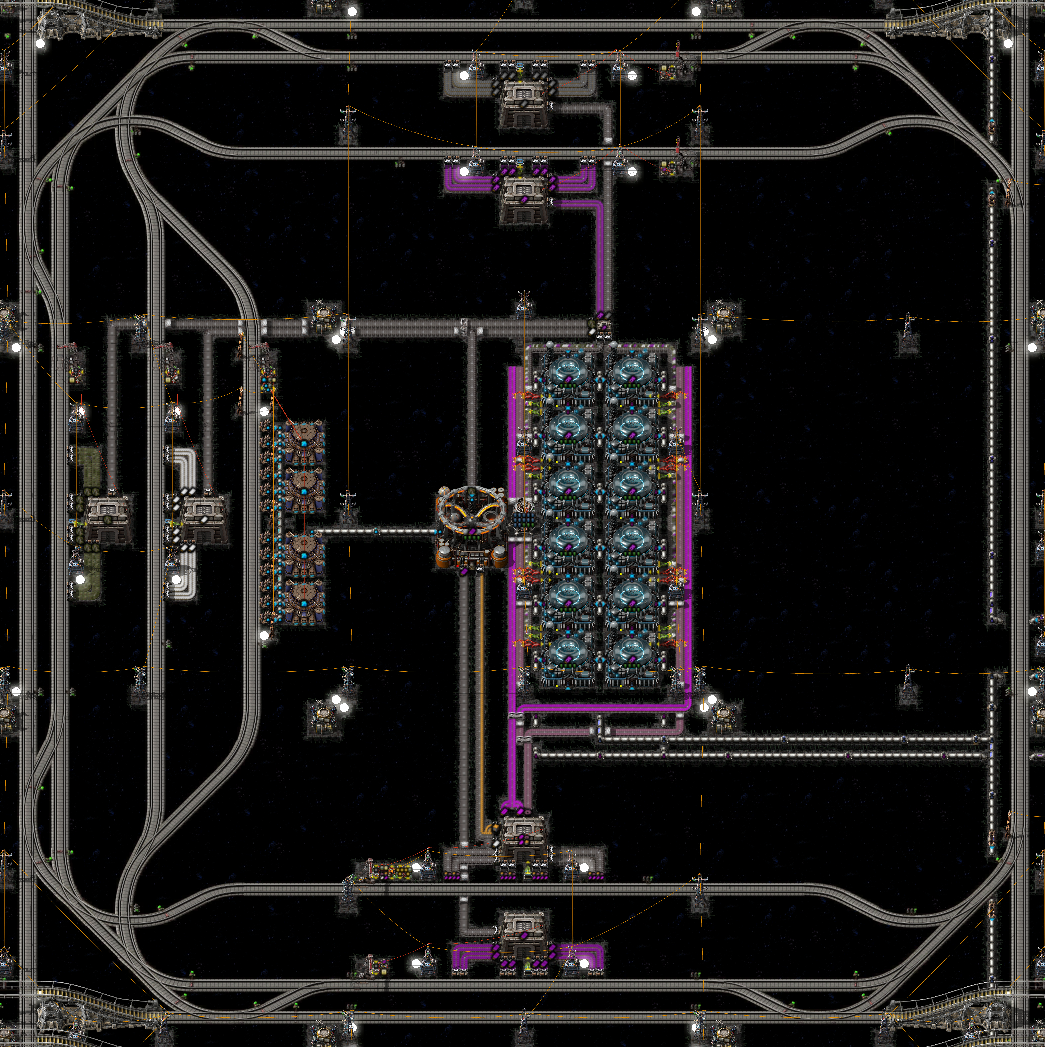
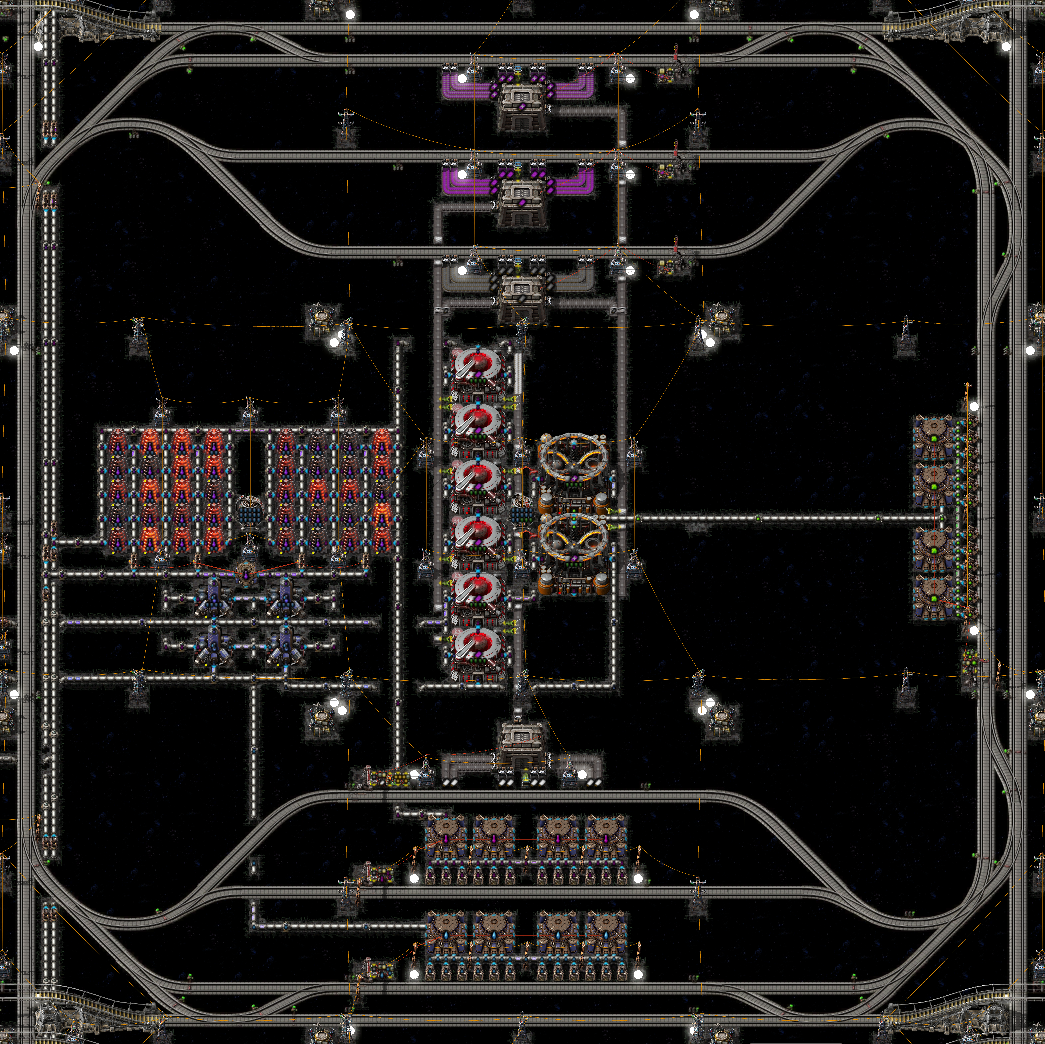
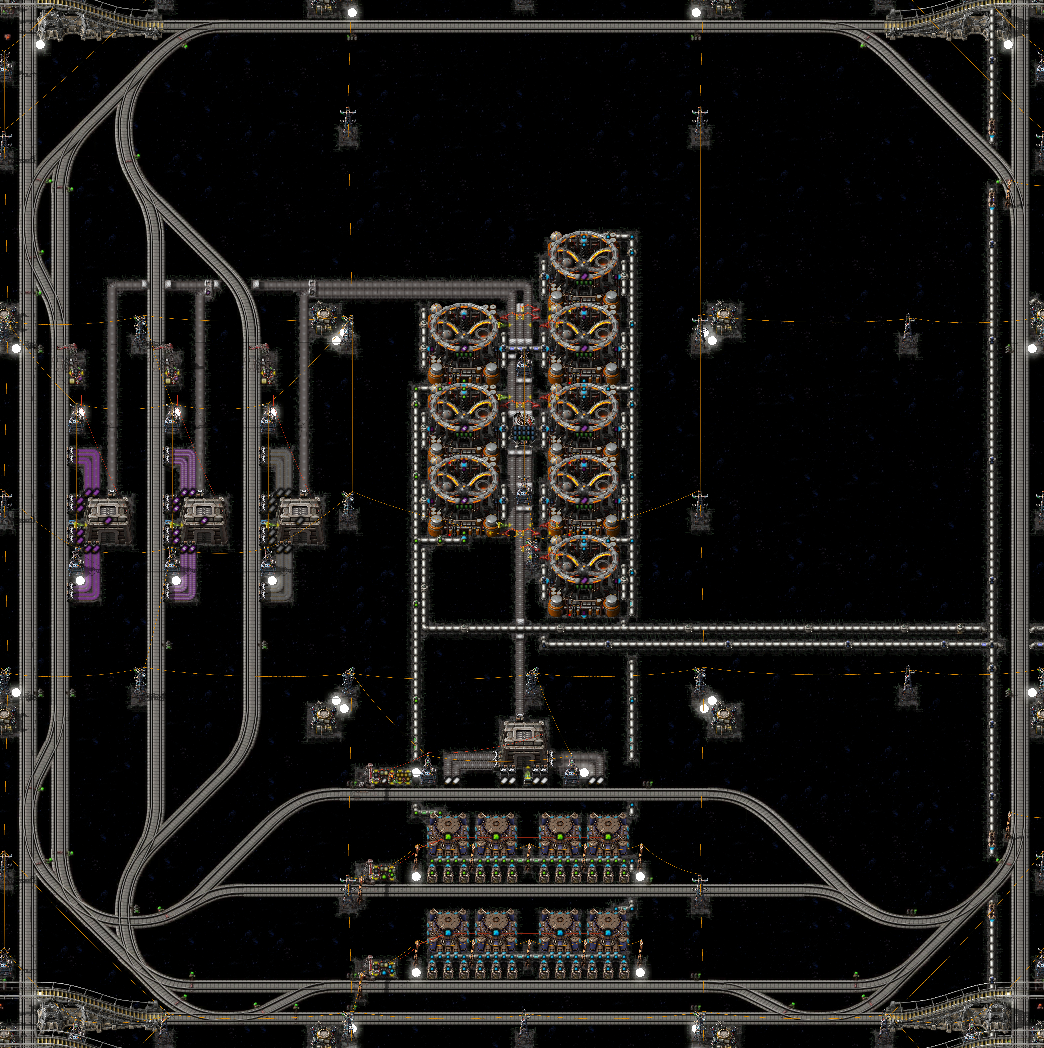
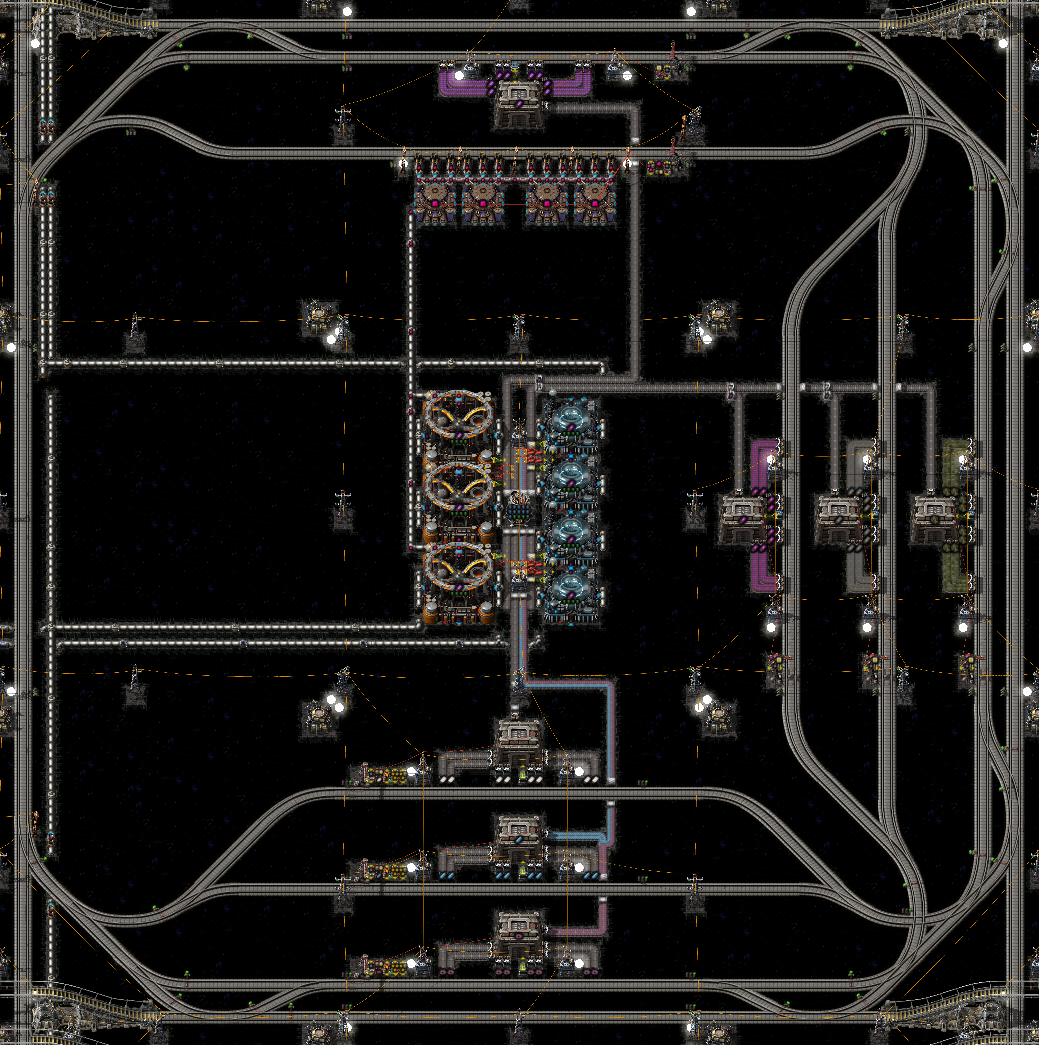
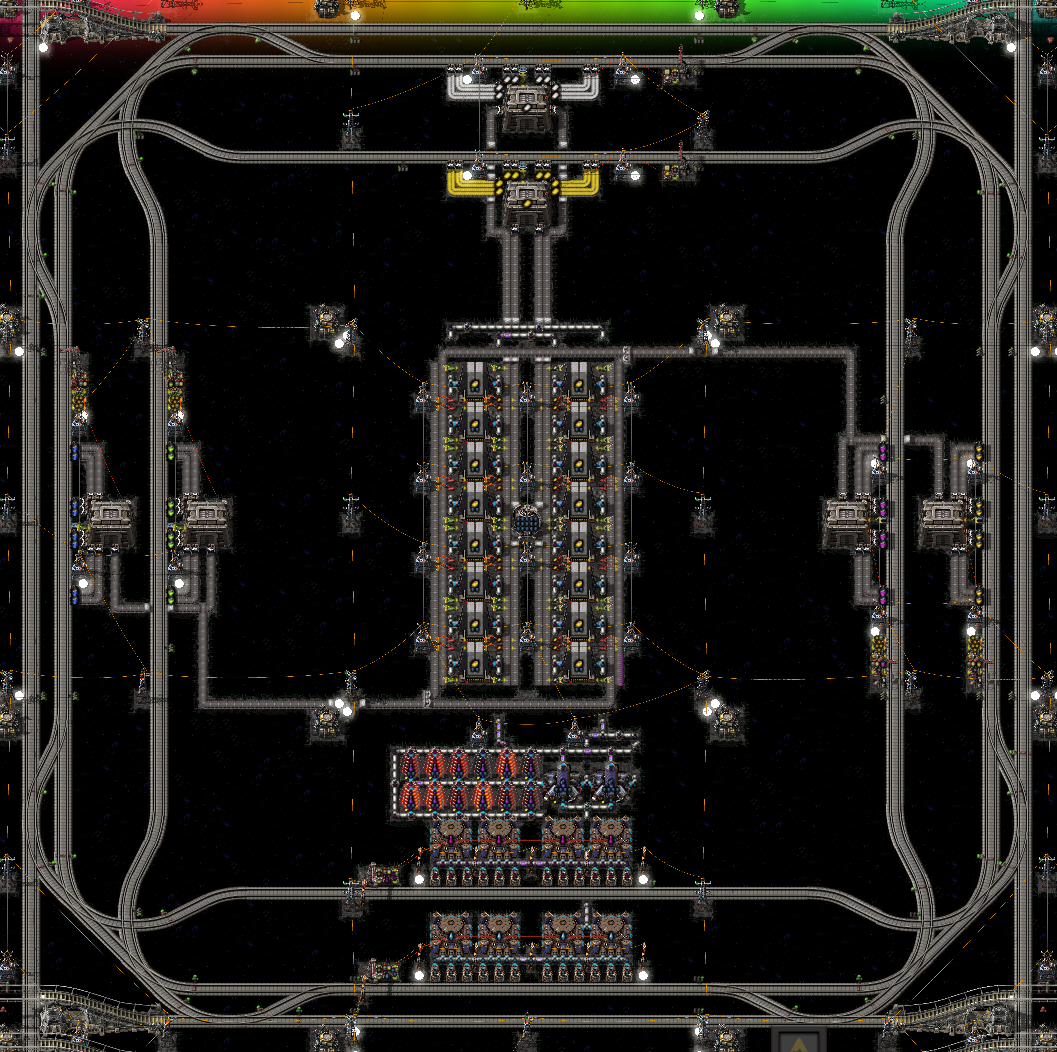
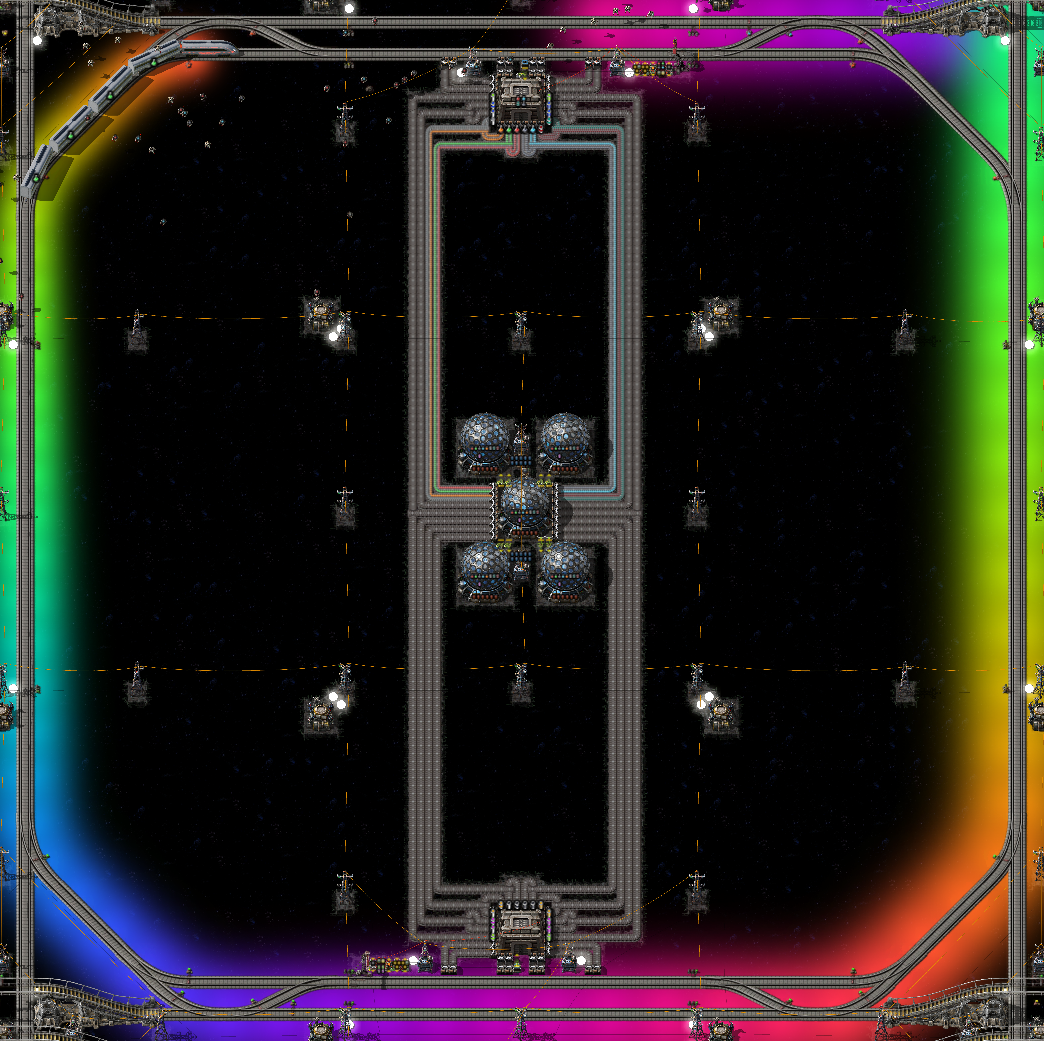
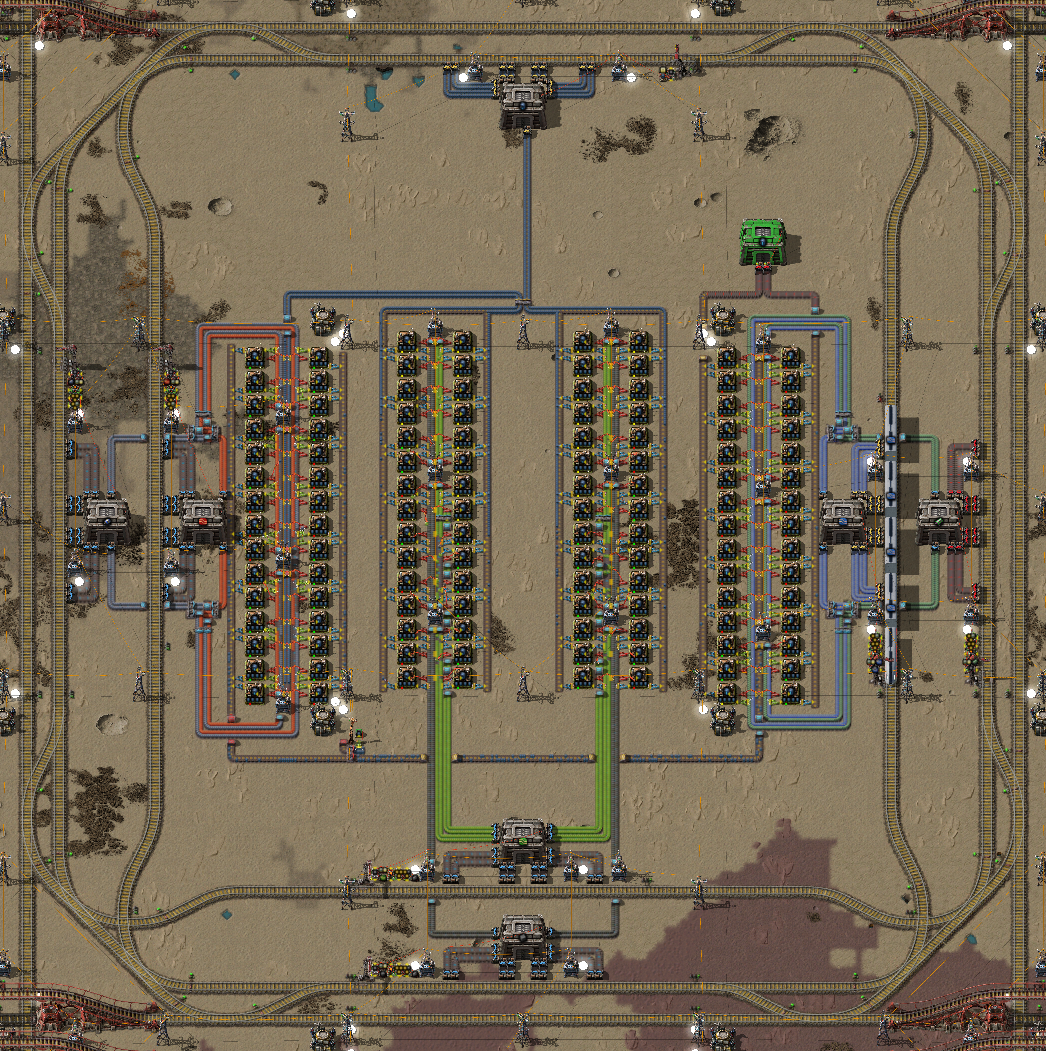
Also, while I am also doing it on Nauvis, I need to set up a block to recycle regular scrap. This gets converted into some iron/copper ore, stone and heavy oil. The heavy oil is very neat because it pretty much supports all that I'm consuming in orbit, meaning I barely need to send barrels.
As for the ores, I need to send back to Nauvis somehow. I could smelt them in orbit, but (1) that would be a lot less efficient than using pyrosmelting + prod modules, and (2) everything is requesting ingots, not plates.
So I've dedicated a block to send these ores back to Nauvis. I've put it right below the block that receives high volume items from Nauvis, because those generate a lot of empty barrels. I am recycling those into steel and sending that steel also down to Nauvis (again, there's the ingot/plate issue).
I can't wait to be done with all of this barrel and plate nonsense!!
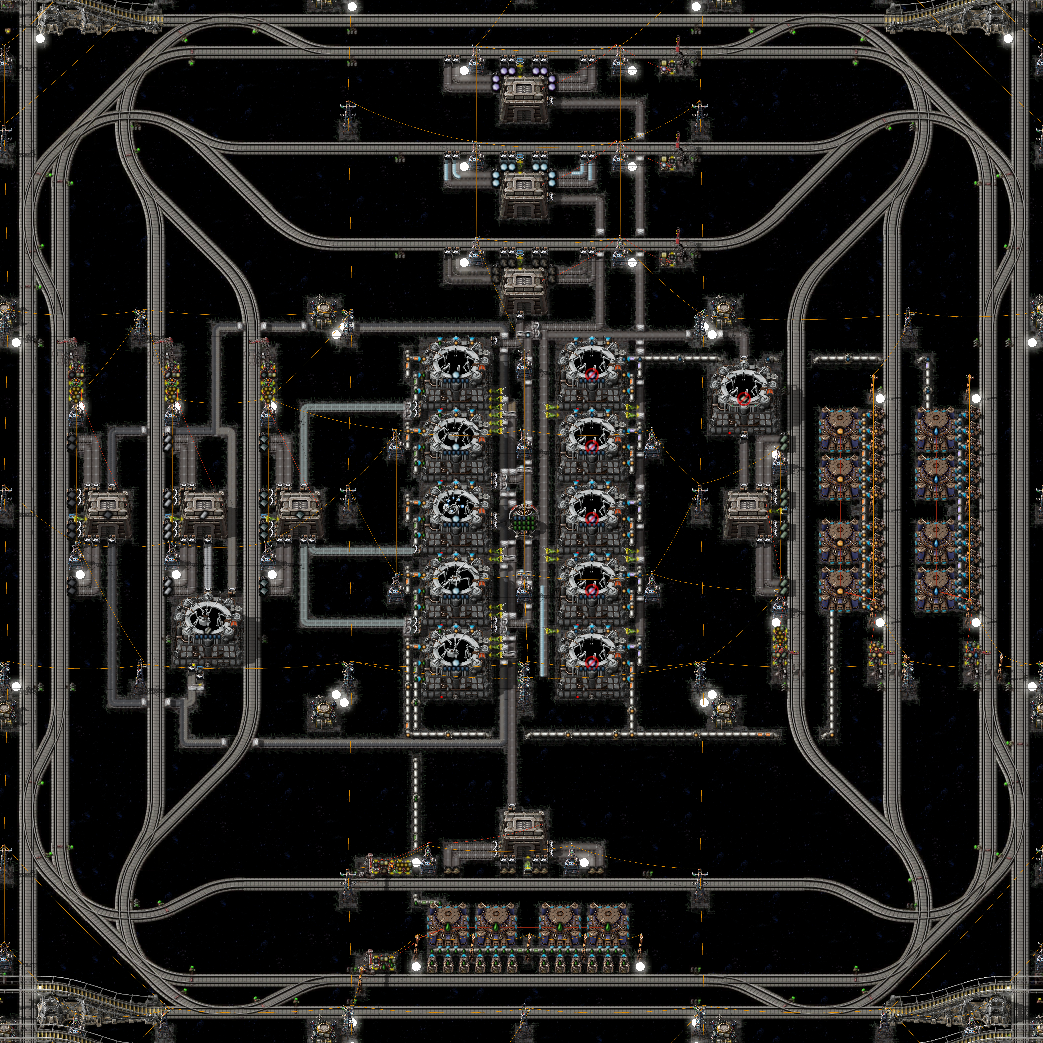
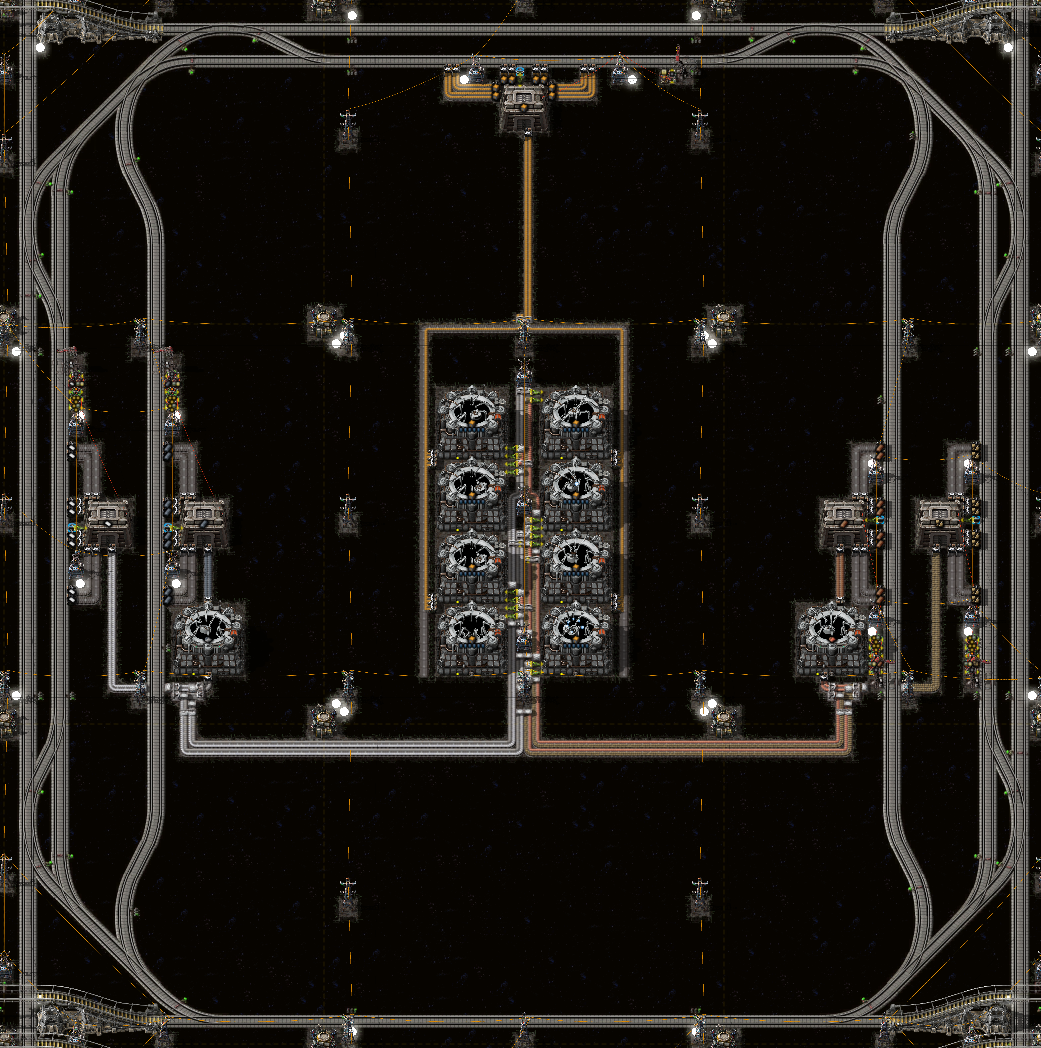
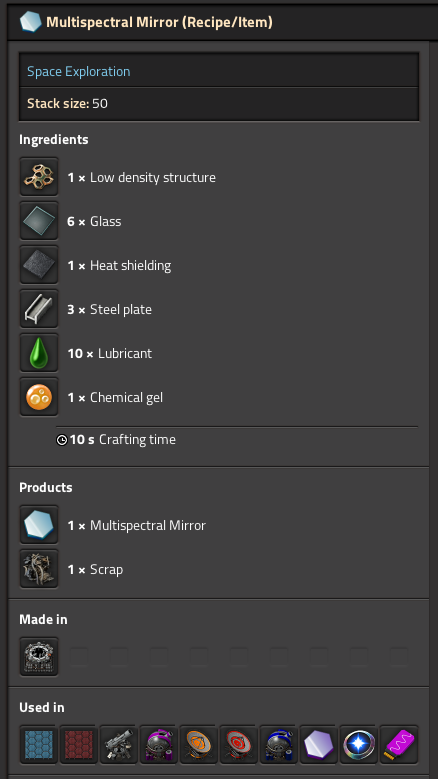
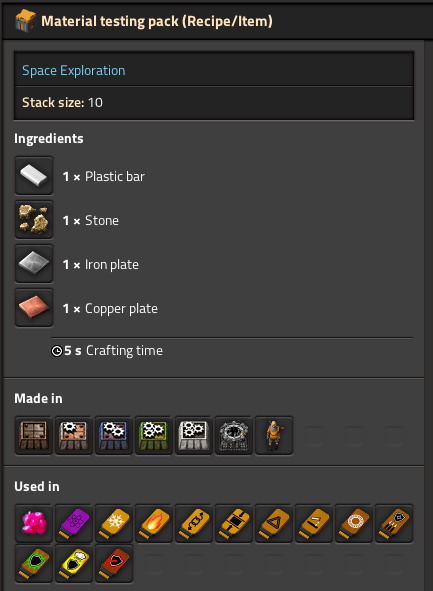
[88:16h] The next blocks are for multispectral mirrors and material testing packs. I need both to make energy science, so they get a block each.
Mirrors can be made fast enough that I've also fit their upgraded version, gamma ray detectors. I can't make them yet, but it won't be long until I need them. This block can make 900 of each per minute.
The block for testing packs is temporary, because they can also be made on Nauvis (with prod modules). However, their tiny stack size of 10 means it's not worth it. In the future it will be, though, so that's why I've put the block on the outskirts of my city. I am making 2700 per minute.
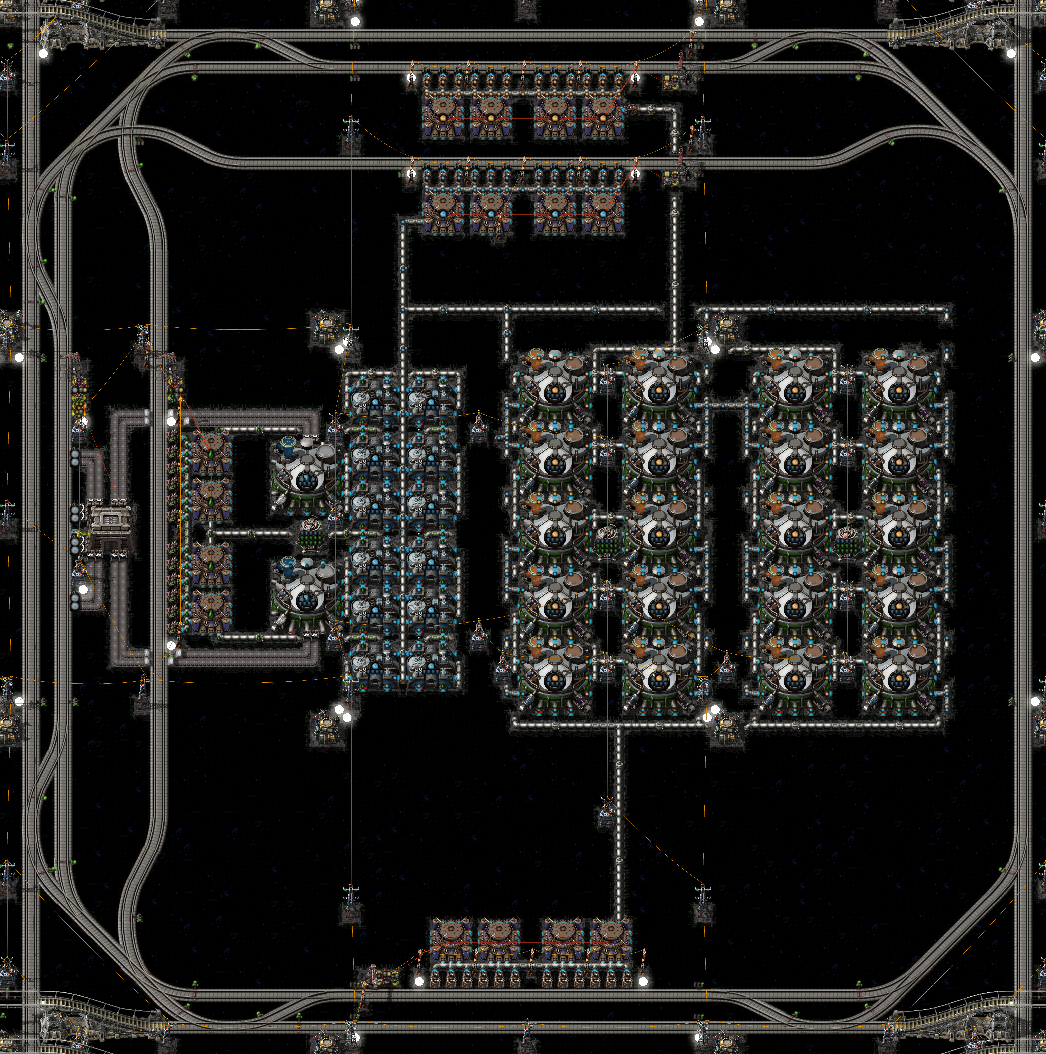
[88:31h] Another basic material in space is chemical gel, which is made from cosmic water. I've put them both in the same block, but if in the future I need to separate them I have room just next block.
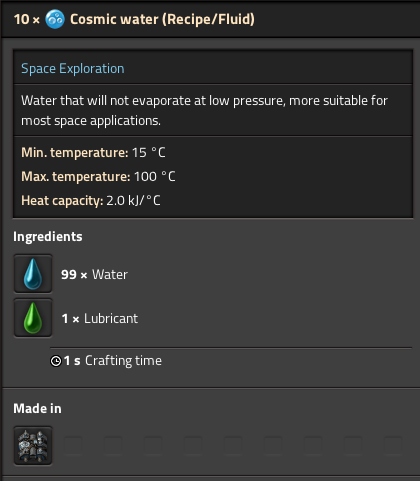
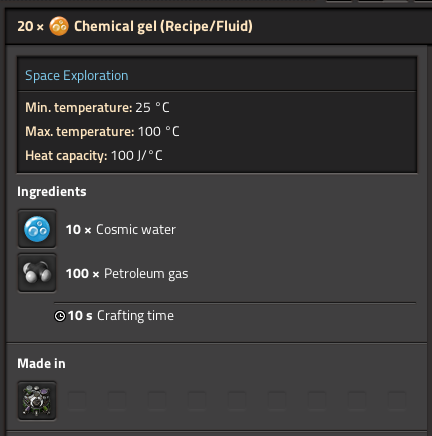
Cosmic water is just regular water mixed with a bit of lubricant so it doesn't evaporate, and chemical gel is that mixed with petroleum.
By the way, in case you haven't noticed, in most of these setups, the beacons have a lot of efficiency module 3s. While energy in space is cheap, I still haven't reached the point where I can mass produce it, and I'm in a chronic LDS shortage so I can't spam scaffolding either. So it's important to be energy efficient, and I don't need the extra production yet.
In the future it will be easy to change to full speed modules if needed, and takes much less time than re-doing the entire block.
[90:33h] The only remaining ingredient to start making science is the colour clouds.
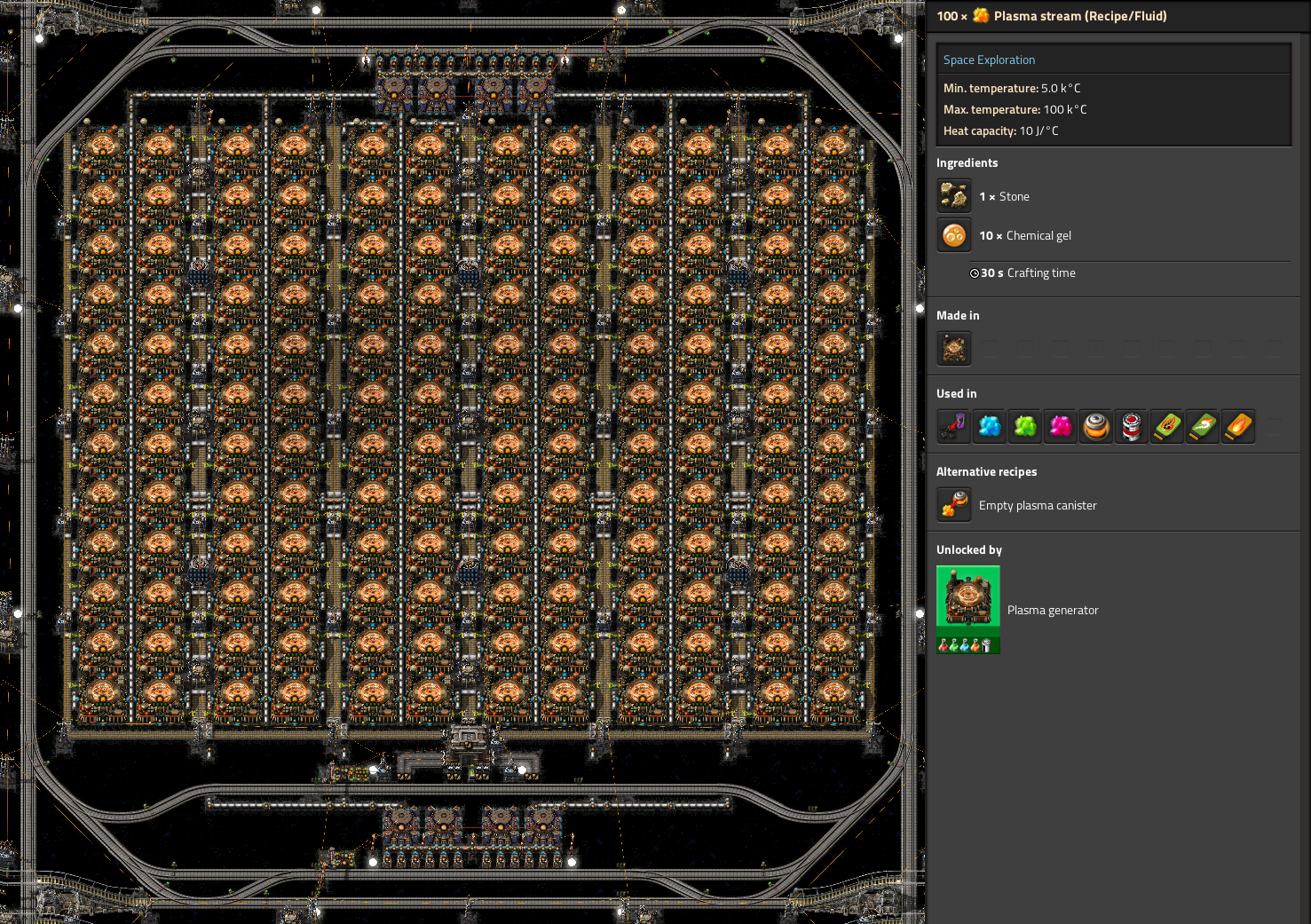
The first one is Plasma stream (orange cloud). I placed a LOT of machines because it's required to make all the other ones.
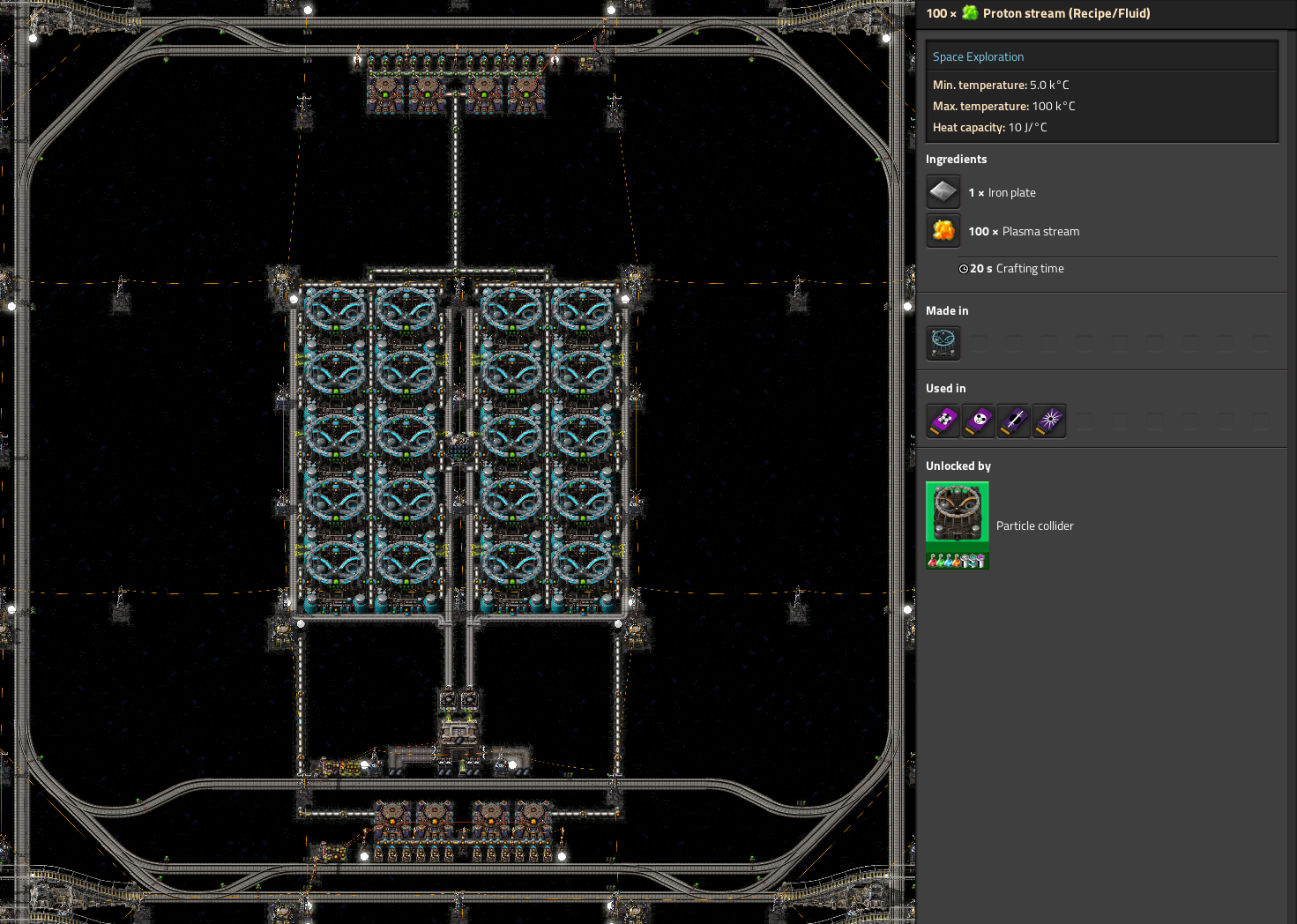
Besides that, I only have enough scaffolding to make Proton stream (green cloud).
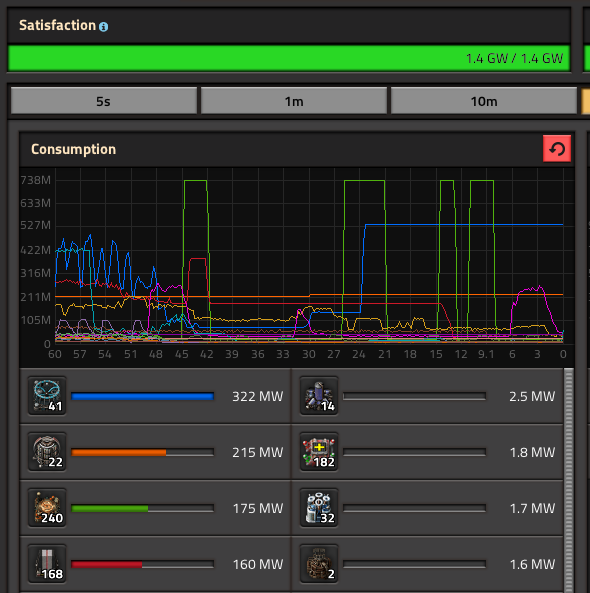
These recipes are very cheap, but the real cost is in energy. I've had to even use one speed module 2 for the proton stream to make the machines reach the -80% energy cost, as -70% was not good enough. Even still, just 20 machines are the biggest power draw in my base by far - 400 MW!
I'll wait to add the rest of clouds since I don't have the scaffolding for that many solar panels - one day I'll have enough LDS...
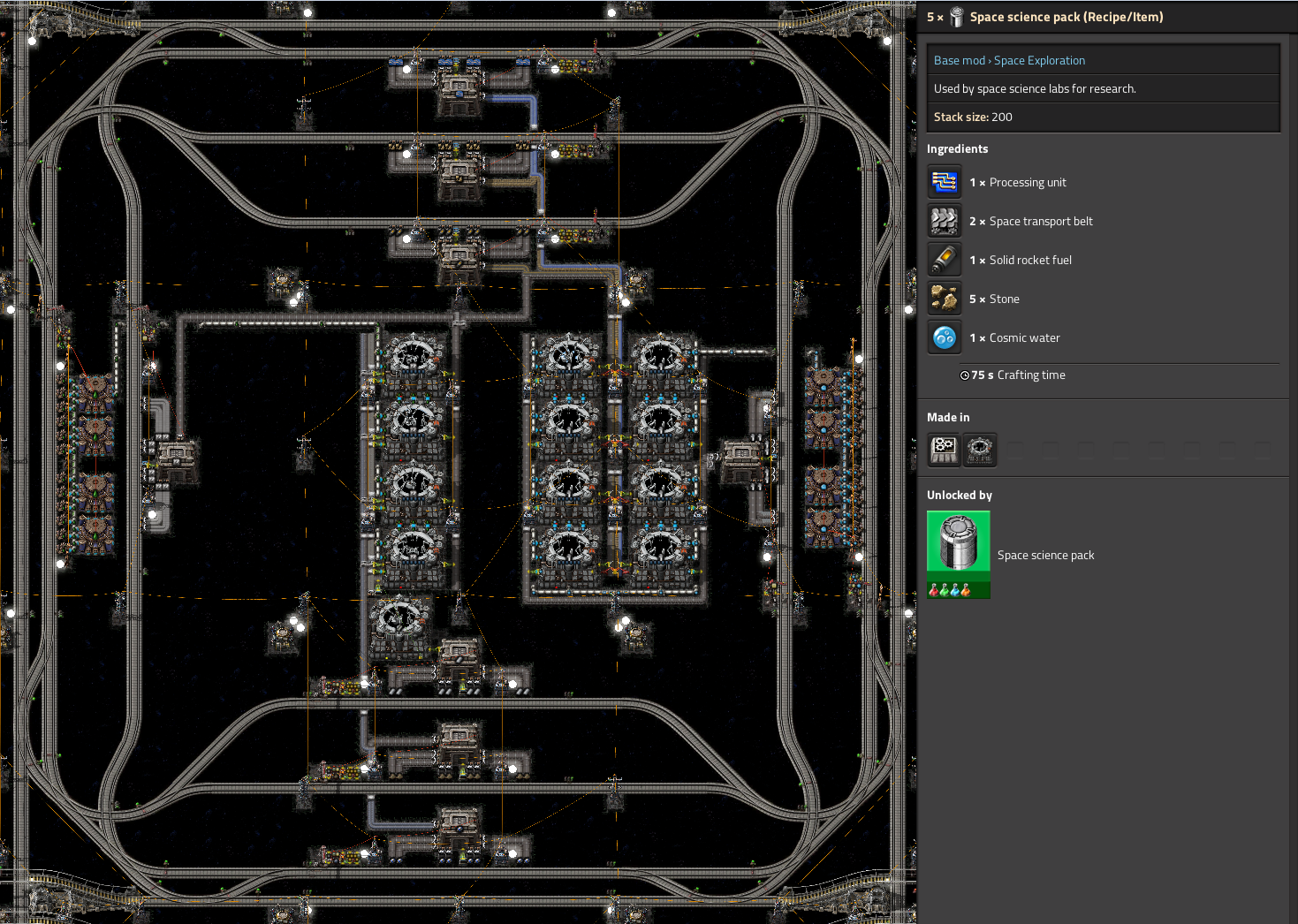
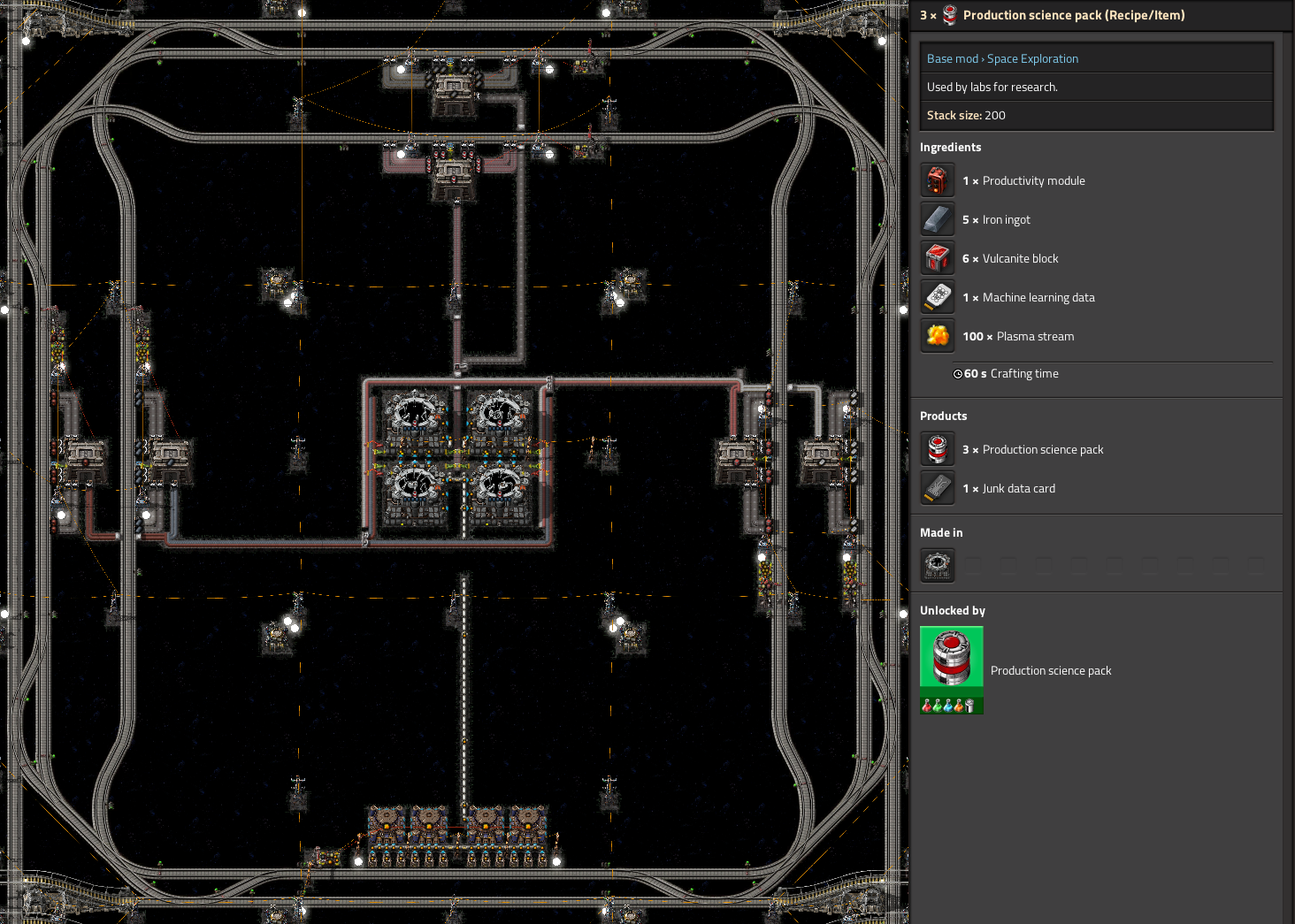
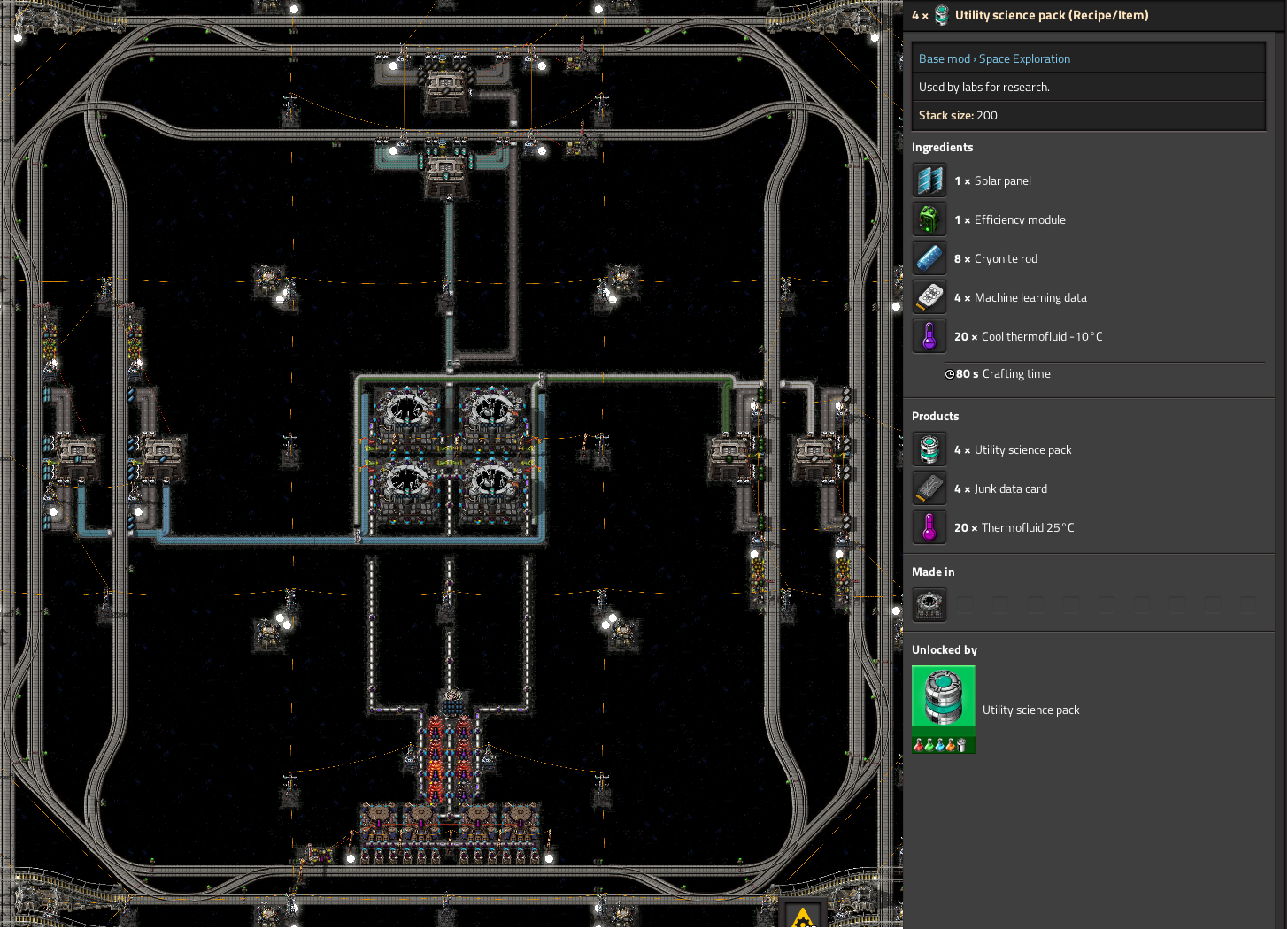
[90:45h] Finally, I'm creating blocks for the first three sciences.
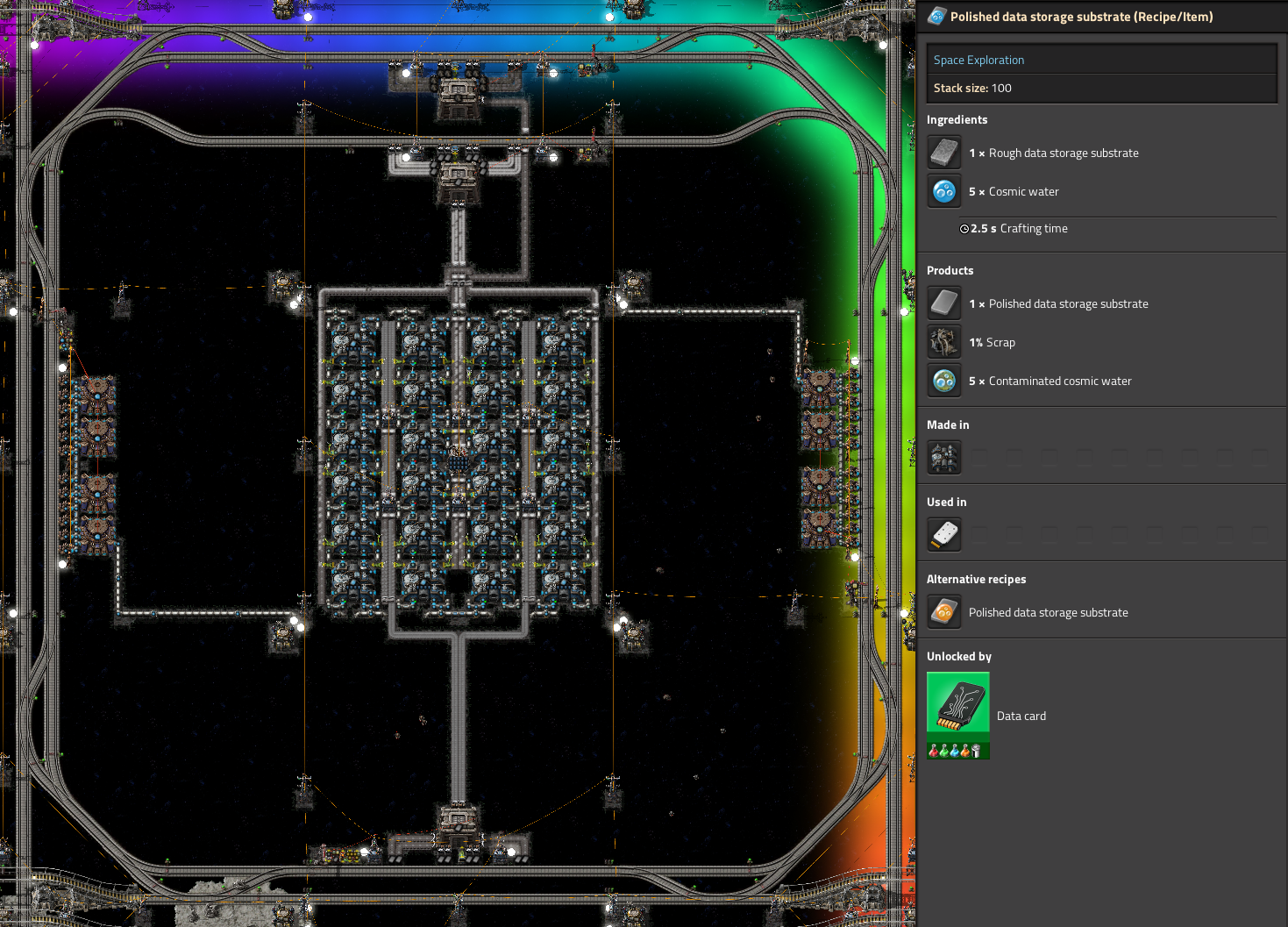
There's nothing fancy here, I don't need a high production of these so the blocks are pretty empty. I am limiting the output warehouses to just 100 stacks, because otherwise it would be a big waste of data cards.
While I'm waiting to have more LDS to create blocks for energy science, I decided I'm tired of waiting and I'll be going for the next science type. I have three options for it: Astronomical science, which requires beryllium Material science, which requires iridium Biological science, which requires vitamelange
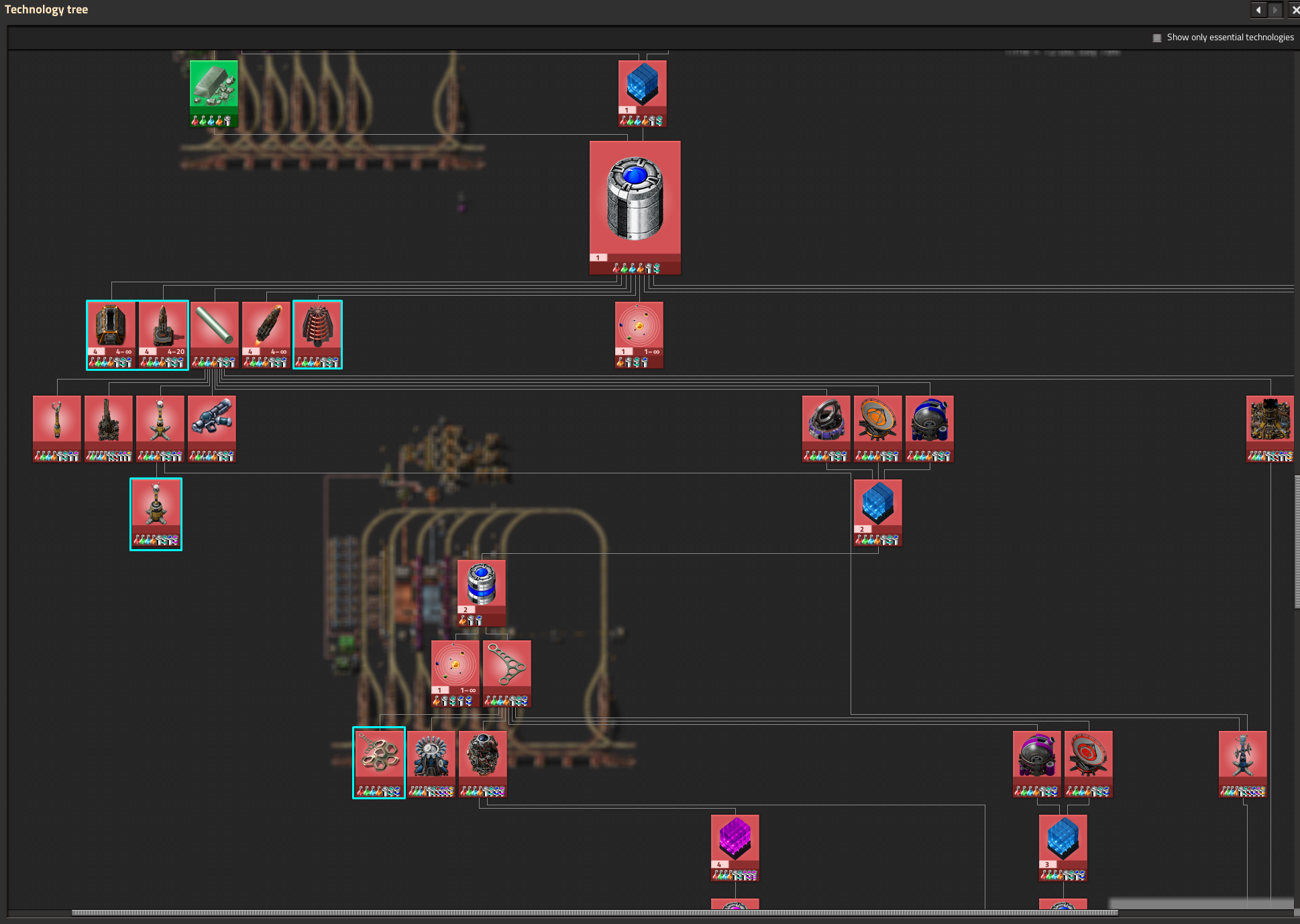
I'll be going for the first one. It has a bunch of nice techs scattered across: Improved rocket safety and reusability (I'm tired of having rockets crash!) Better power poles Better thermofluid cooling Better recipe for LDS (YES PLEASE) Spaceships!!
So, my next goal is to go to a new place to mine and process beryllium
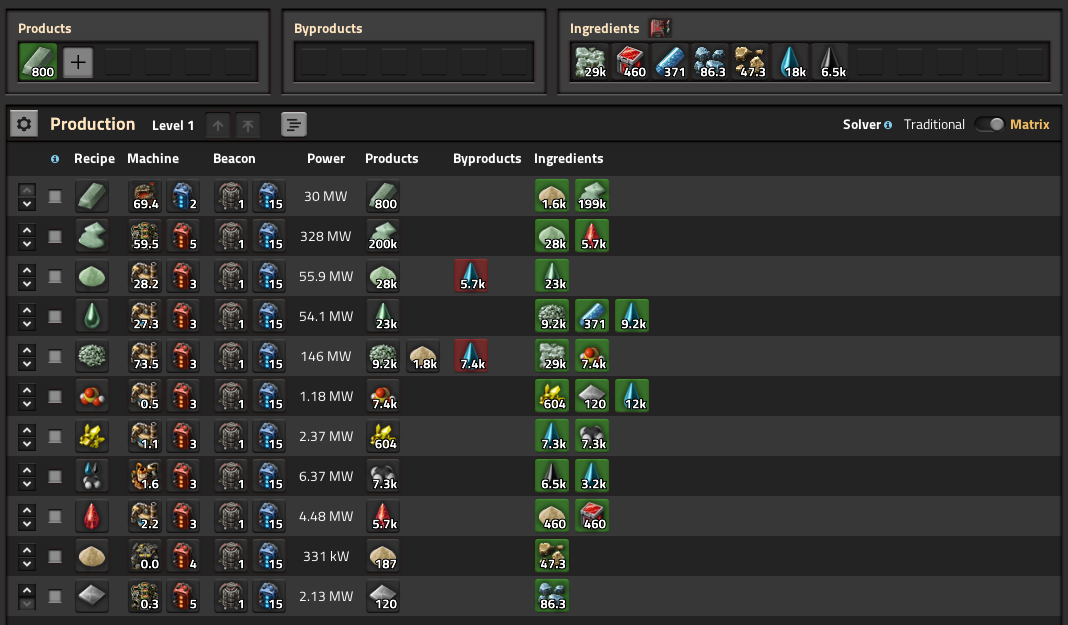
Here's the factory planner for beryllium ingots. I'm aiming to make 800 ingots per minute as that is more than enough to make astro science. The ore is processed like this: Beryl ore is mixed with sulfuric acid to make beryllium sulfate, also making sand and water Sulfate with cryonite and water makes beryllium hydroxide, a fluid Hydroxide is then dried into beryllium powder, making extra water Powder is melted with pyroflux Molten beryllium with sand is casted into ingots
This process actually produces a surplus water, so I'll have to get rid of it, and has a small sand deficity, so I'll need to import some.
As for inputs, I'll need vulcanite, cryonite, oil, and small amounts of iron and stone.
So, where do I have beryllium? One quirk of this element is that I'm only guaranteed to have it in asteroid belts, not planets. Asteroid belts have some upsides, such as having patches with hundreds of millions of ore. However, since productivity can't be used, they're generally worse than planets.
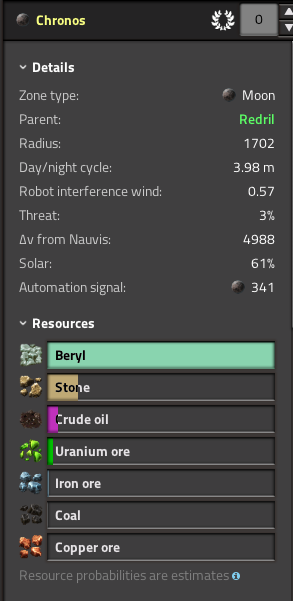
Fortunately though, I have a couple beryllium planets. So my options are: Asteroid Belt: It has iron, stone and ice, but no oil Chronos: It has small quantities of everything I need, plus no biters Yasha: It has a bunch of biters and is also waterless, which is a no-no Aestas: my vulcanite planet actually has quite a lot of beryllium too. However, I don't think it's enough, as I need 29k ore per minute.
So, with all this considered, I'll be going to Chronos!
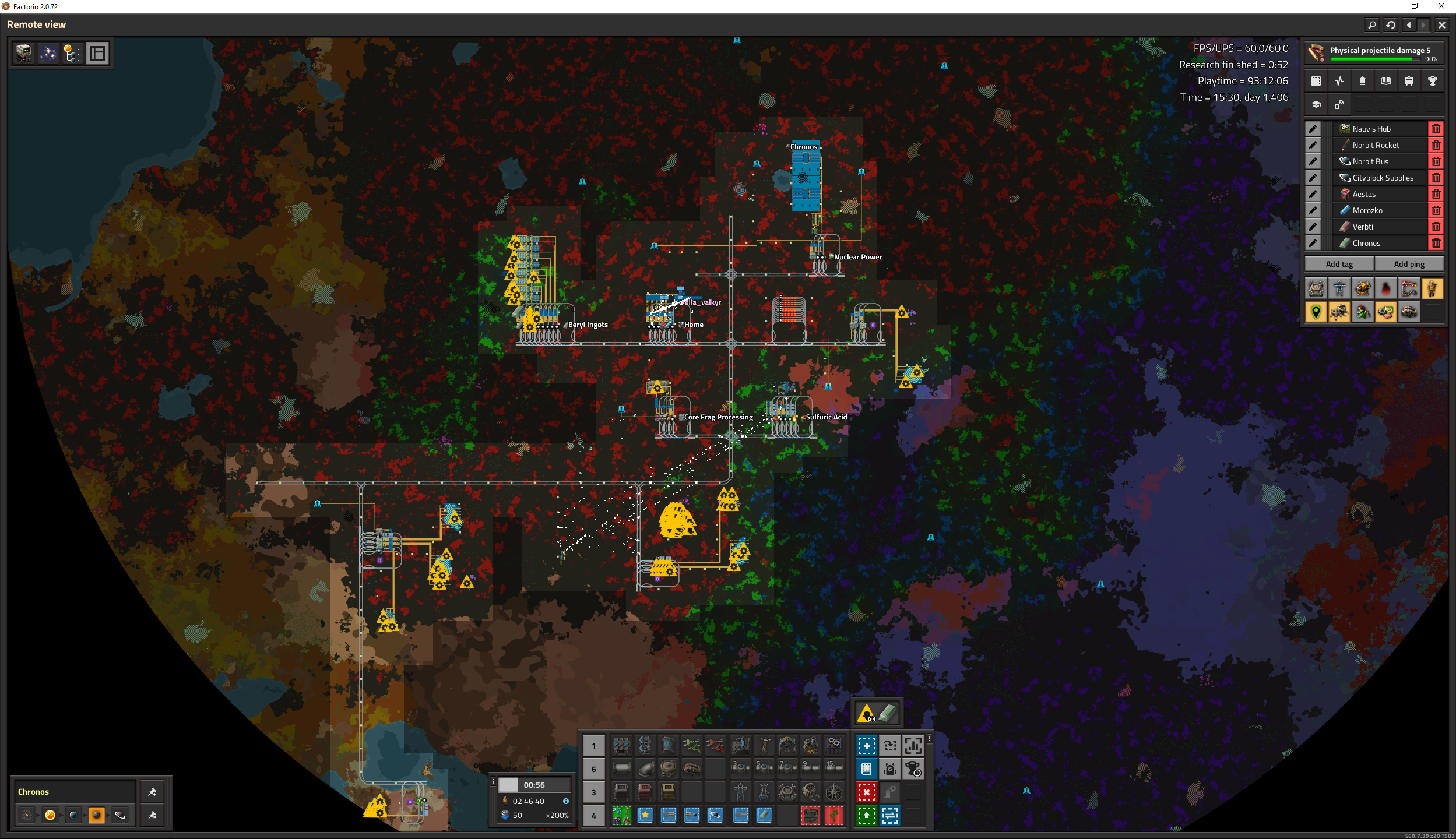
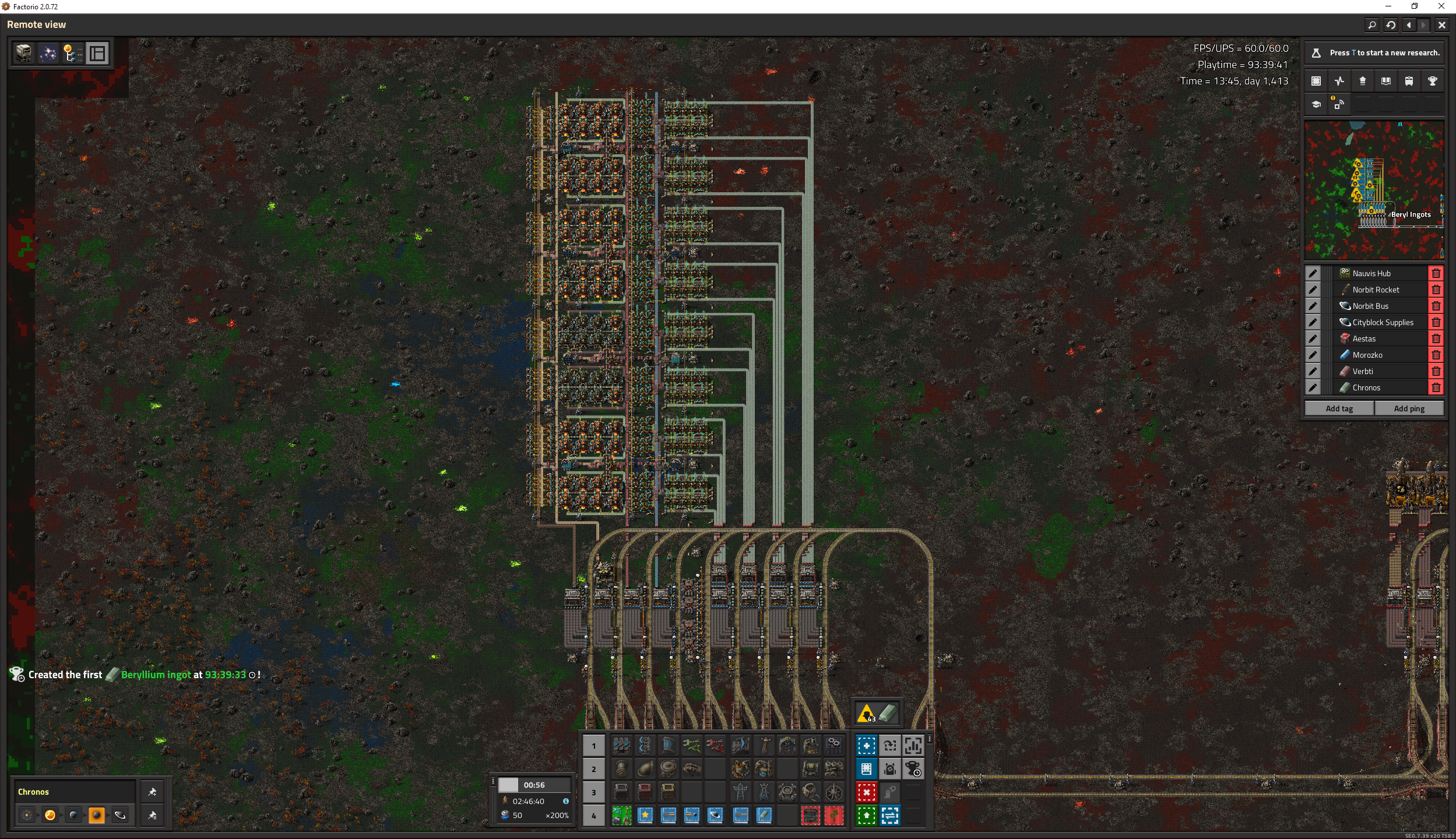
[93:12h] I've landed on Chronos and built a base there. It's pretty much the same process as always so I won't bother repeating it here.
The subfactories I've made in this planet are the various mines (including iron, oil and uranium), the plant for processing core fragments, the oil factory (which makes sulfuric acid and rocket fuel), the big beryl factory, and the home factory, which sends and receives rockets from other planets.
Everything is ready to start making Beryl ingots, however I'm having big shortages of Vulcanite and Cryonite, so I never got those delivered in this planet. Guess beryl will have to wait until I expand those!
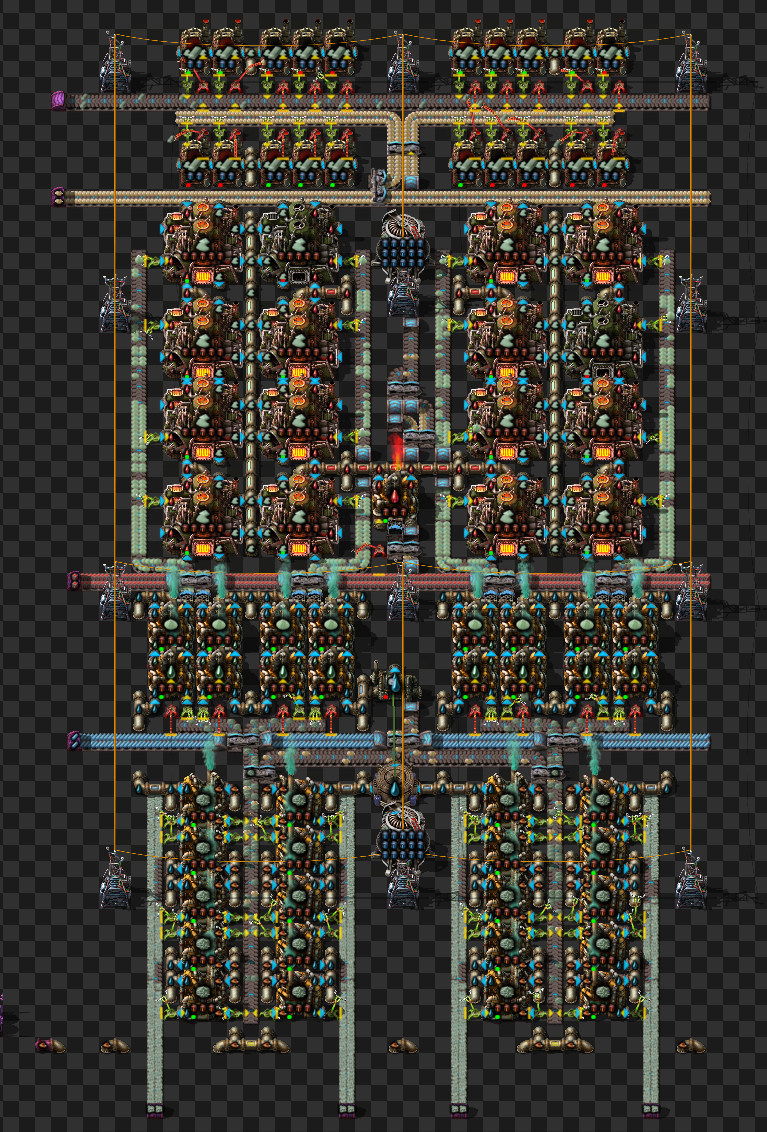
[93:39h] Here's the detail of the beryl plant. I've divided the production into four pairs of blades, with each blade making 100 ingots per minute (so 800 in total). In the first picture there's a blueprint of a blade pair.
From bottom to top you can see the processing steps I explained earlier. The water pipes are all connected to a tank, which voids it when there's too much. Also, the sand made by the first step is moved to both make pyroflux, and also to the final casting to ingots, with a little help from the outside as the process is sand negative.
And hey, the vulcanite and cryonite arrived, so I made the first ingot!! yay
[93:51h] It's time to shift my attention back to Norbit. While I was making Beryllium, I accumulated enough scaffolding to continue building. So I'll finally be adding energy science to the cityblock base.
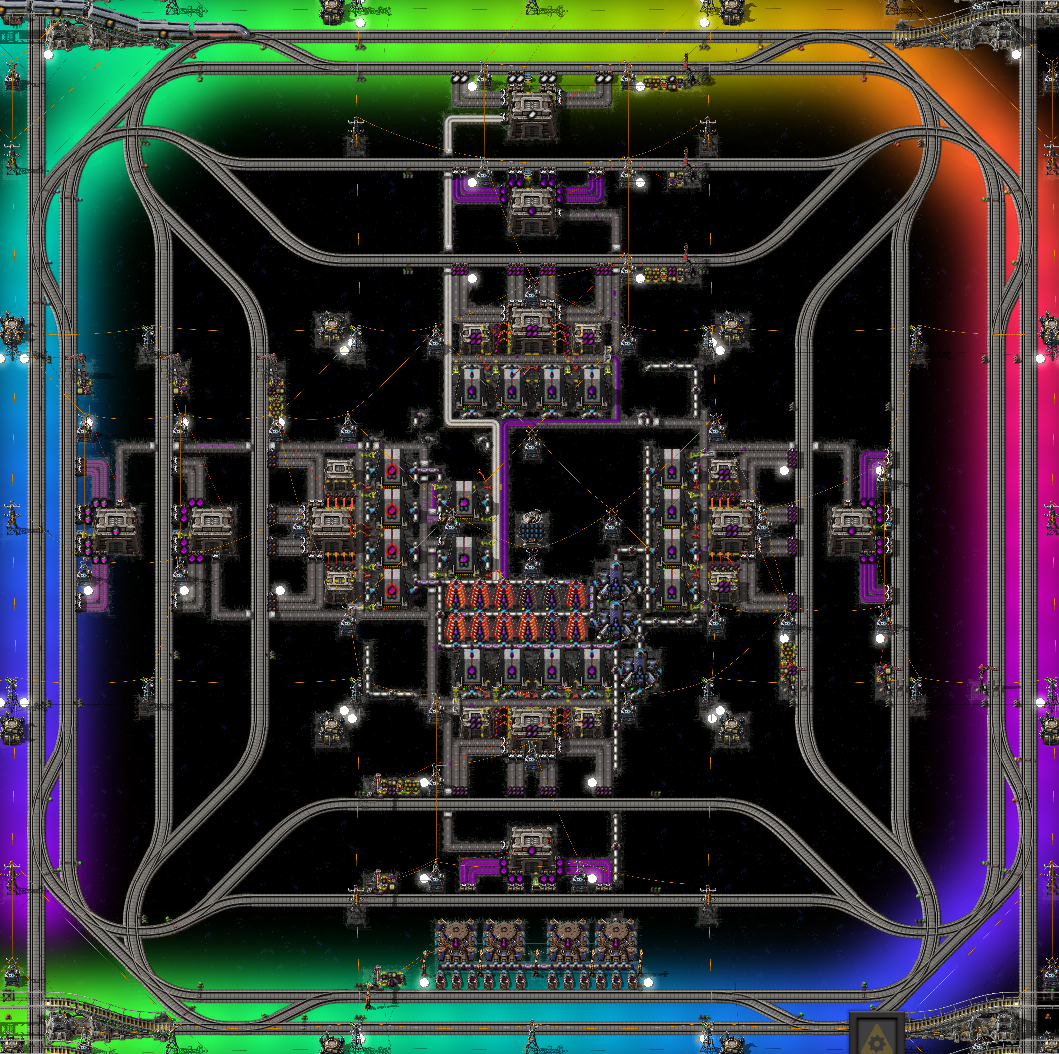
Like I showed in the planning, energy science will take 2x5 blocks of space. The first row will have one block that receives all data cards and makes all catalogues and insights (as those take just catalogues), and another block that receives that and makes all four science packs.
Below that, each row is dedicated to making the four data cards of one catalogue, two in each block. This will leave plenty of space for all the necessary stations and buildings, and it has a nice symmetry.
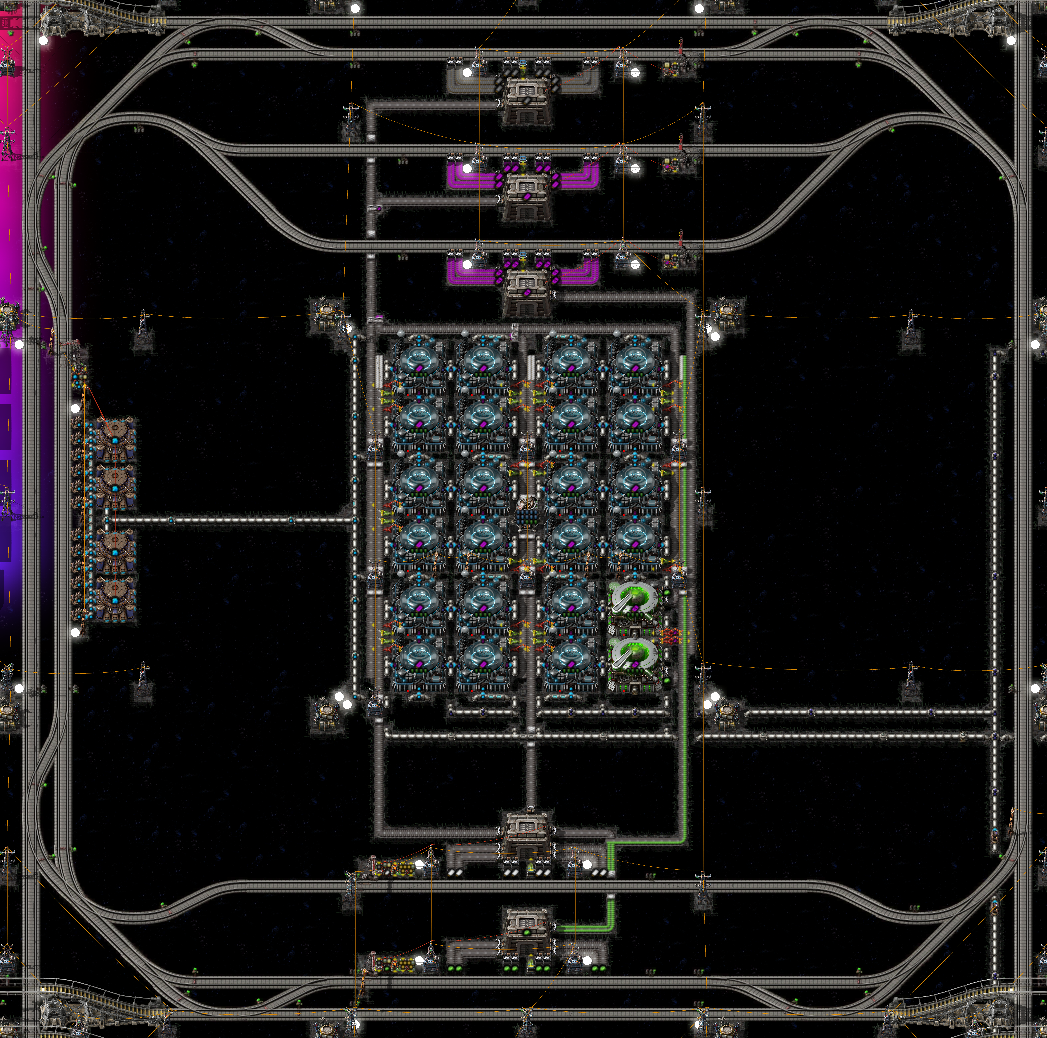
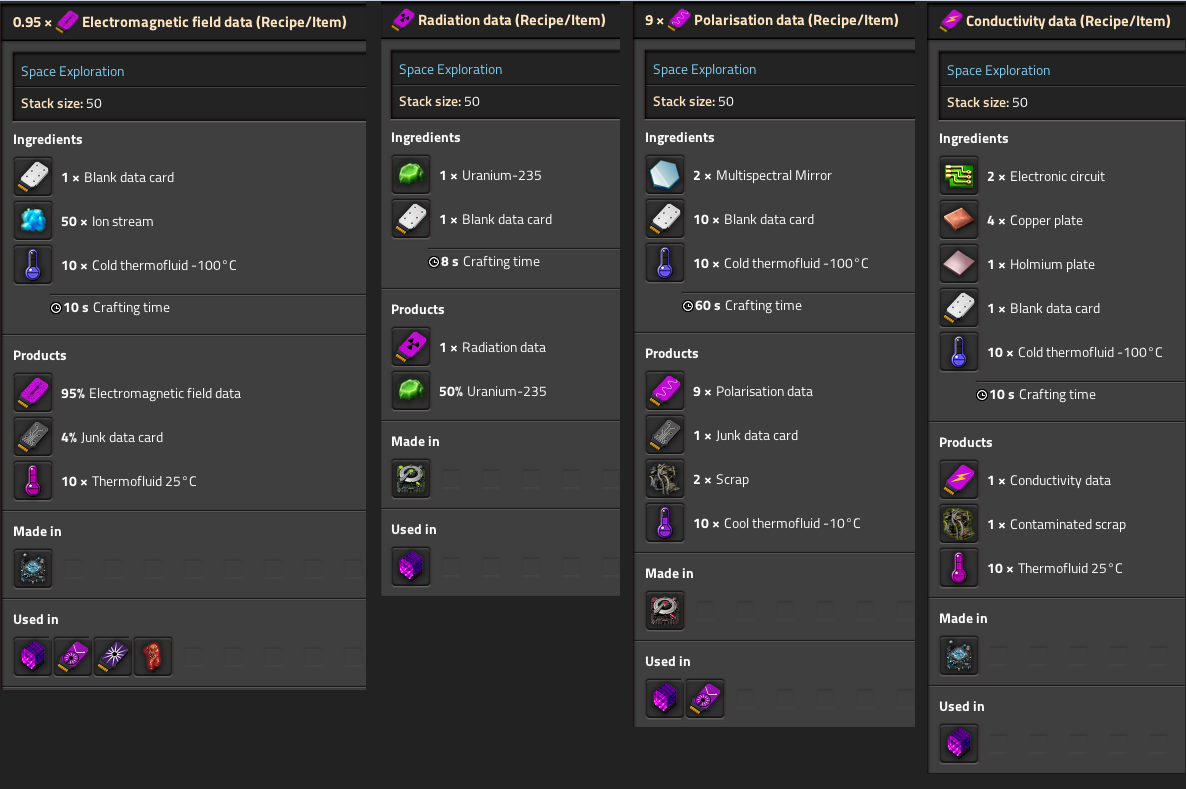
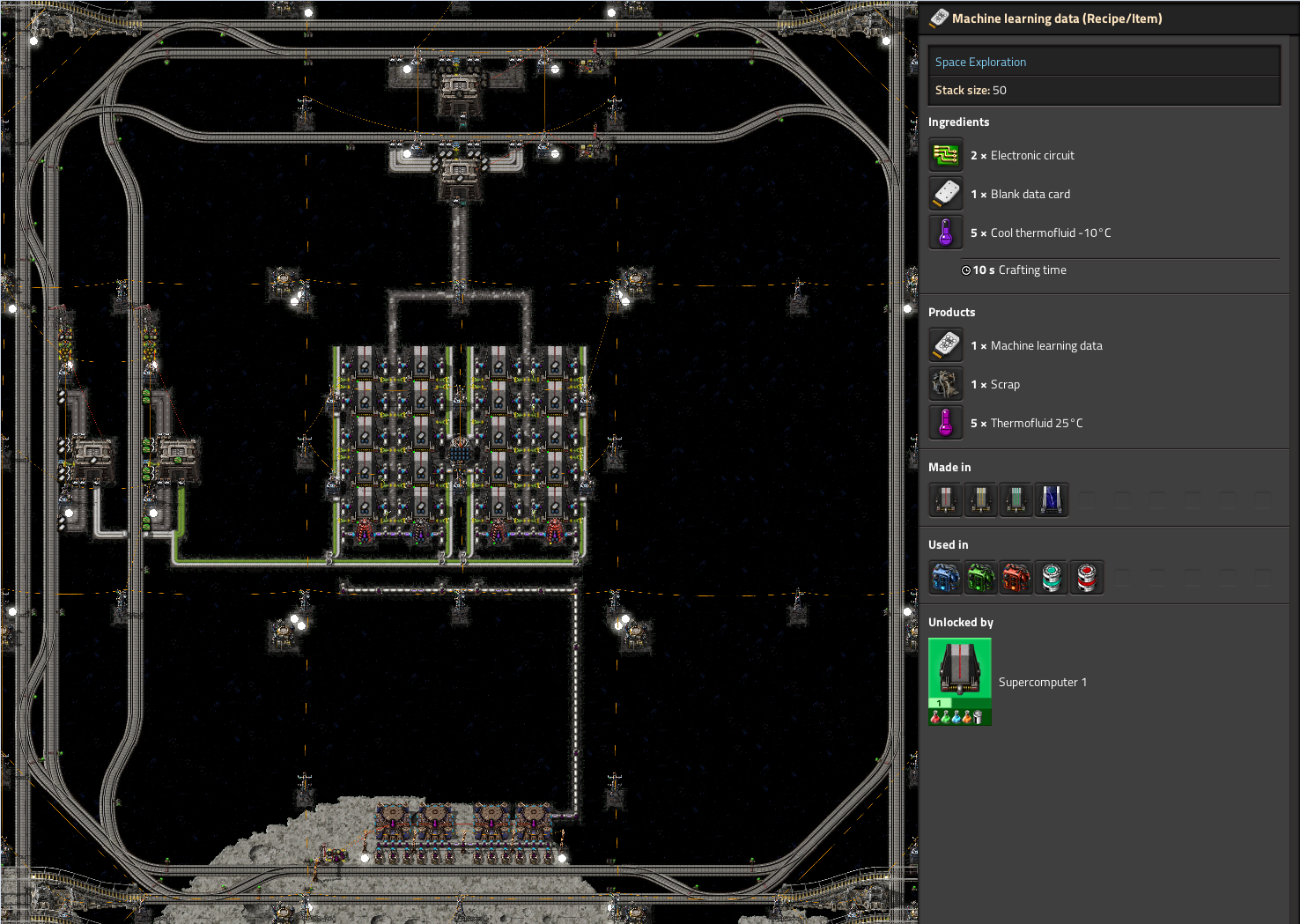
I'll start by showing the first four data cards. The first block mostly makes EM Field Data. I need a ton of machines because this data card is also used as an ingredient for more advanced ones. Fortunately it's quite cheap, as it costs just ion stream (i.e energy) to craft. In a corner, I have a couple machines making Radiation Data, which consumes quite a lot of uranium 235.
The second block makes the other two cards. To the left, Polarisation Data, which consumes mirrors, and is also used by another card (hence why we need 12 machines). To the right, Conductivity Data, which uses a bunch of different materials.
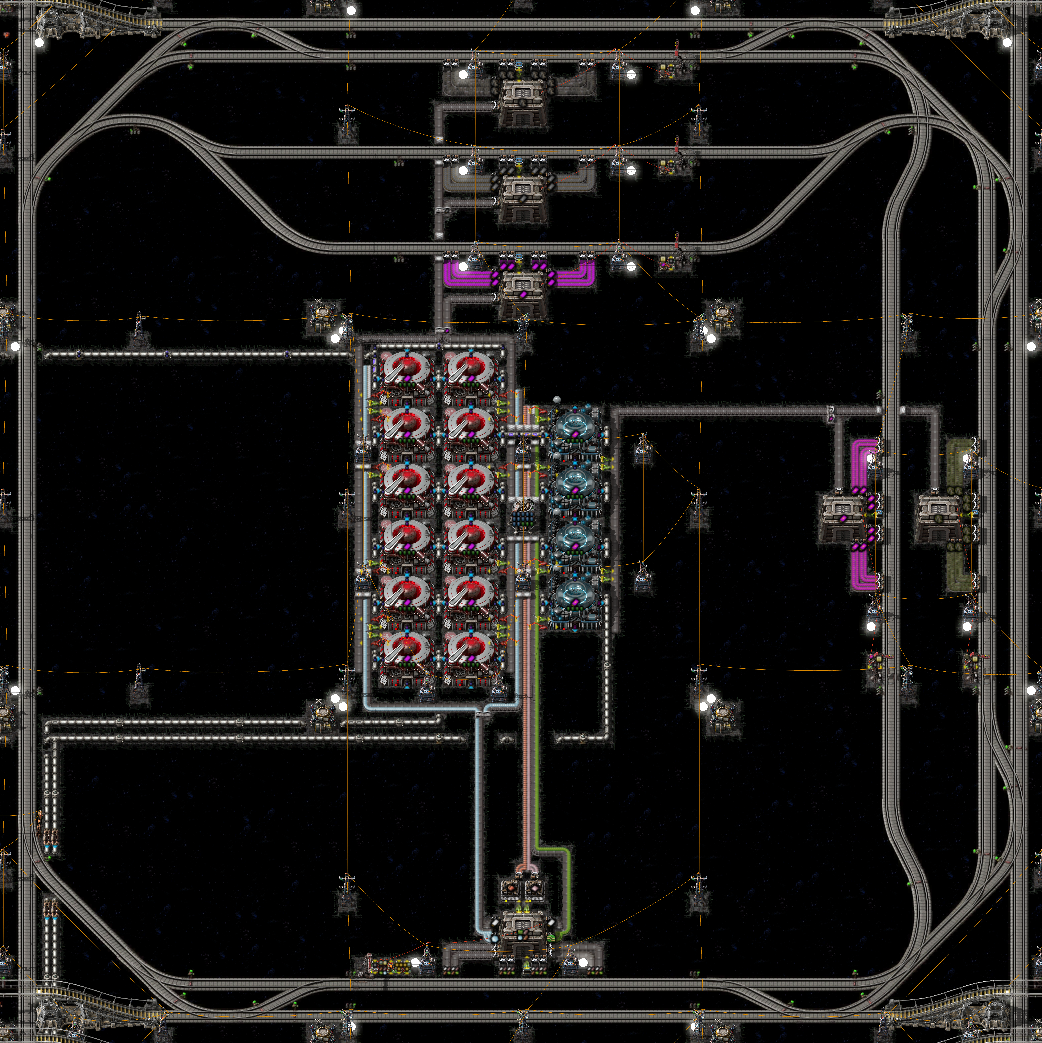
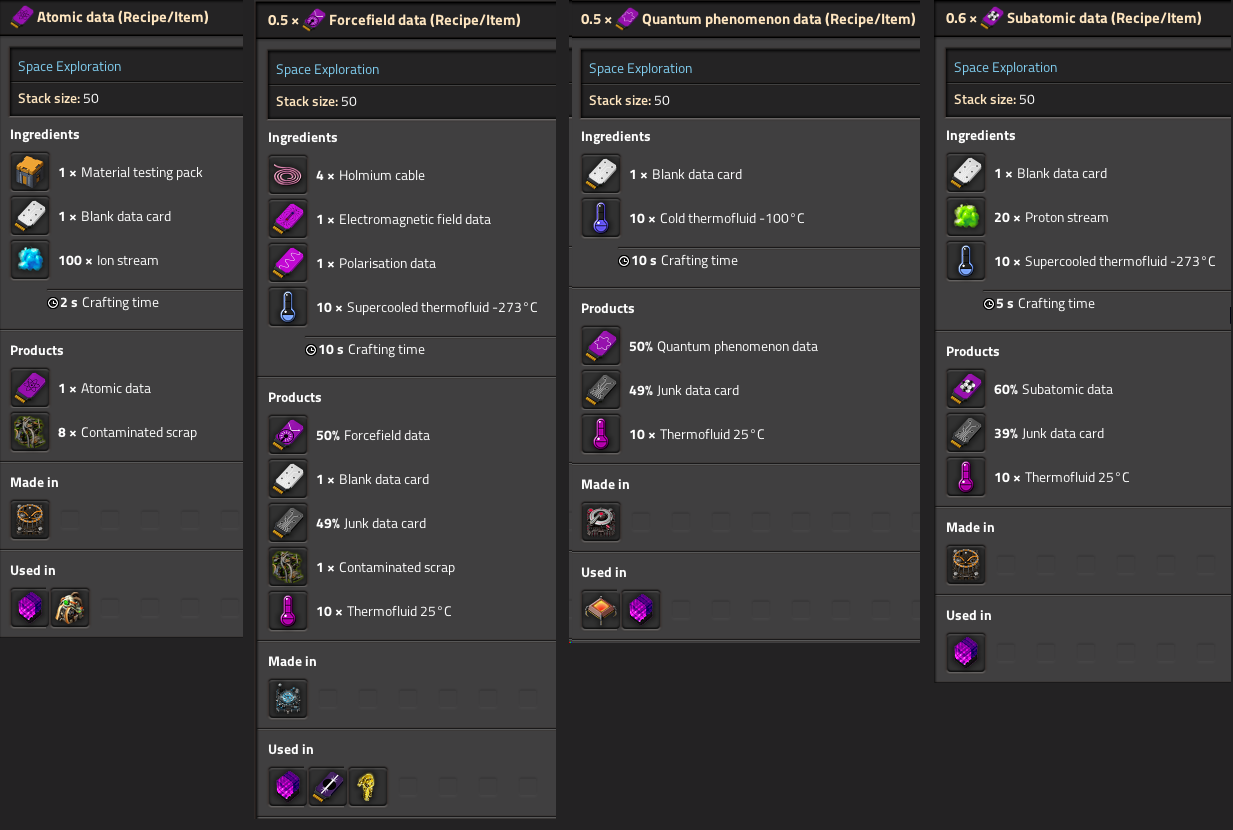
Moving on to the tier 2 data cards. In the first block there's Atomic Data, which only needs one building and consumes ion stream and material packs, and Forcefield Data, which has a lot more machines because it's used for a future card. It also consumes EM Field and Polarisation Data from the previous step.
The second block has Quantum Phenomenon Data, which only needs blank cards but has a success rate of 50%, and Subatomic Data that just needs proton stream.
The second block was empty enough that I was able to fit the thermofluid required for all the energy data cards. I send the thermofluid at all temperatures up and down the city blocks through a "highway" in the middle of the two blocks, this way I avoid having stations for warm thermofluid and cryoslush everywhere.
The tier 3 data cards are very similar, but with lower success rates than the tier 2.
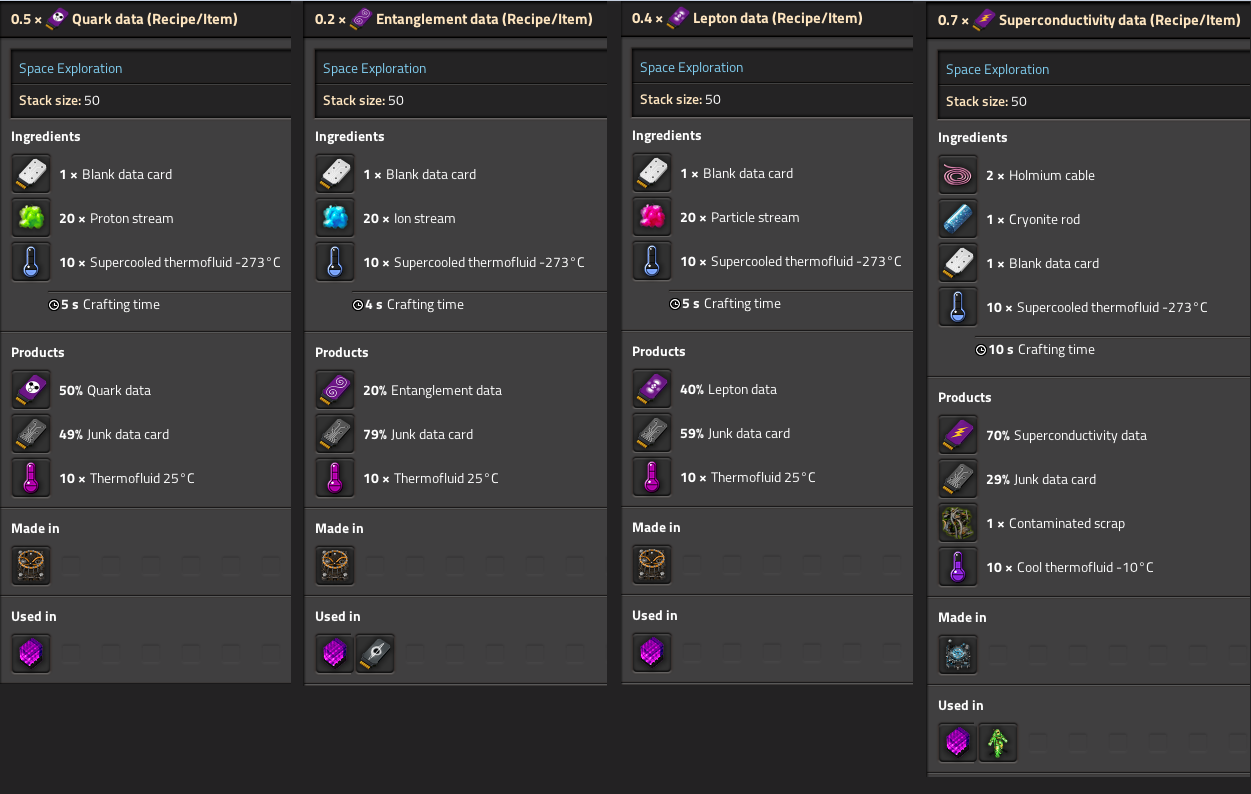
In the first block there's Quark Data, which again requires just proton stream, and Entanglement Data, made with just ion stream but with an annoyingly low success rate of 20%.
The second block has Lepton Data, identical to the last two except it uses Particle Stream, and Superconductivity Data, which uses holmium cable and cryonite. There isn't anything remarkable about any of these cards.
I'll be leaving the tier 4 cards for now, because they'll be much easier to make once I have spaceships.
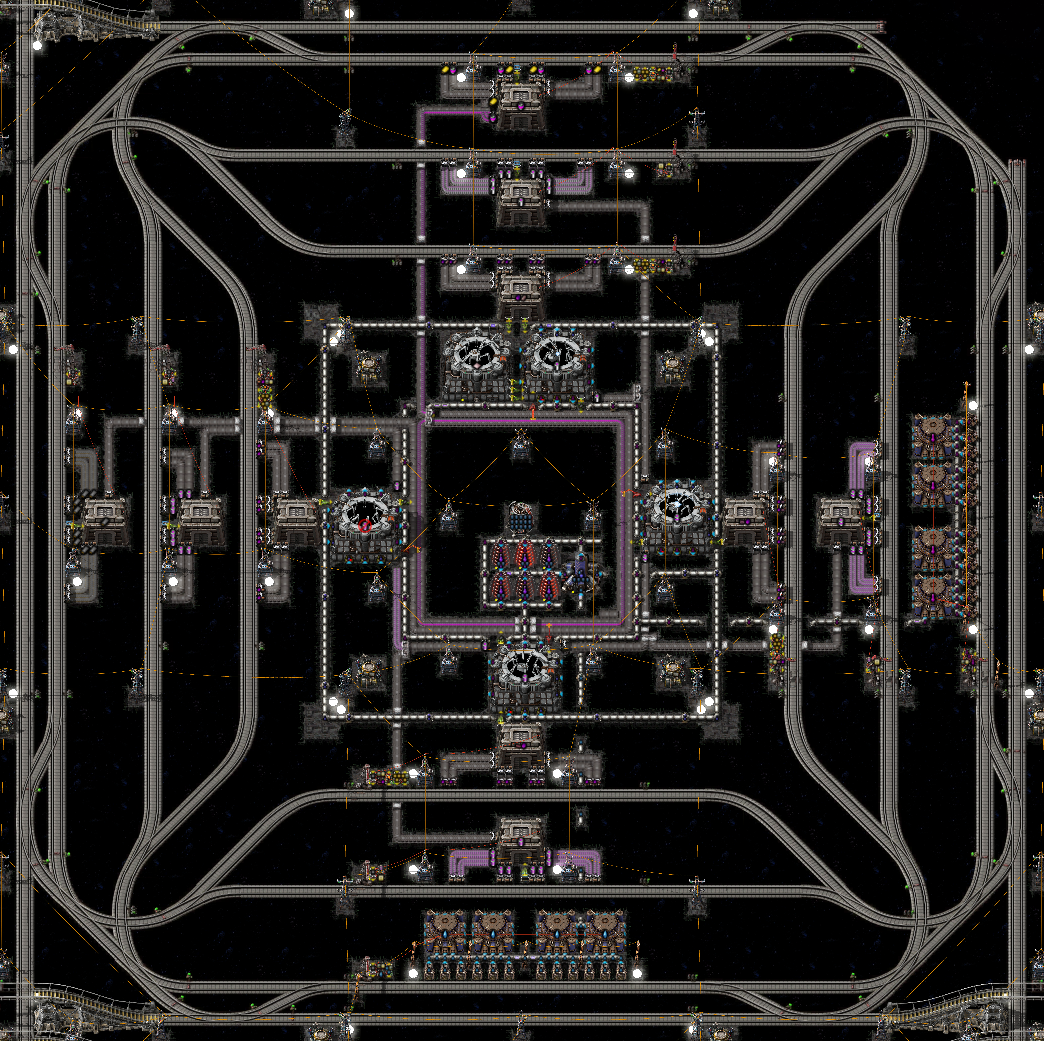
[94:26h] And this is where all of these data cards go, the block that makes energy catalogues! I'm very happy with how this block (and the following one) ended up. Here is a reminder of the production chain to make science.
Since I (eventually) need to make 4 tiers of catalogues, I left one side of the block for each. The four data cards are unloaded at one station, which then unloads to the supercomputers making the catalogue. The warehouses are separated from the station so that the computers are in range of the central beacon, which reaches every machine.
When the catalogues are made, they are both loaded to a station, and also directed towards the computers making insights. The insights are also loaded to a station, ready to be turned into science packs. For now, I'm using the 3rd recipe for making insights, which creates 18 insights with one of the first 3 catalogues.
Right next to it is the block that receives all of that and makes the science packs. It has a similar structure, in that it uses one side of the block for each tier.
On each side, the inner station supplies the catalogues and the extra holmium item required for the pack. Next to it is the assembler that makes the pack. The output goes both to a station and to the assembler of the following tier.
Also, there's a station which receives insights and sig data and that goes to the center of the block so all four assemblers can use them.
The best thing about these last two blocks is that they can be copy pasted for the other sciences, and I only need to change the recipes and requests! They took me a while to make but they will be used multiple times so it was worth it
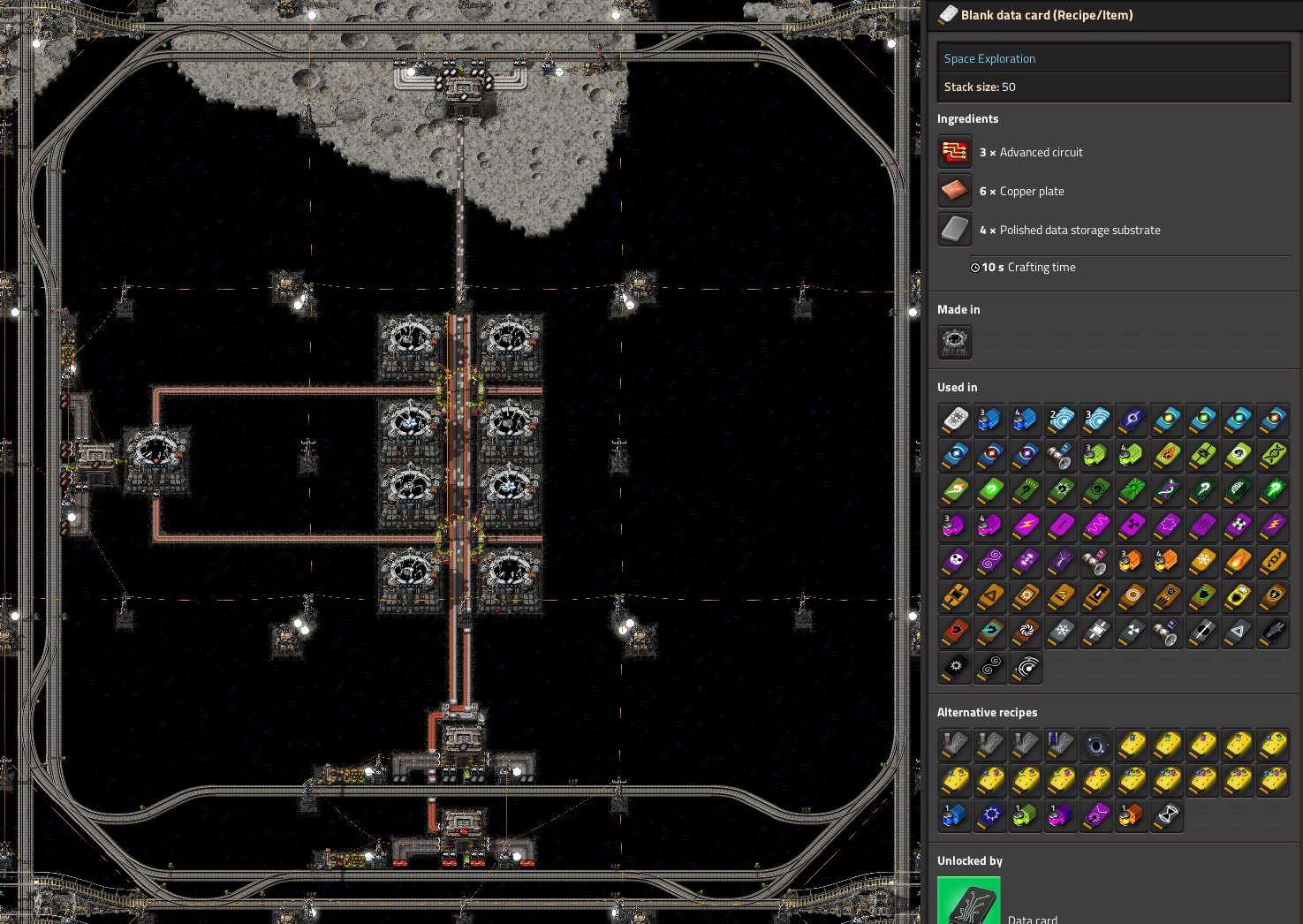
[94:47h] And finally, the last two things I need to make science are significant data and the labs!
Significant data is pretty simple. The block receives insights of all types and some thermofluid. For now I'll be using the least efficient recipe because I only have one type of insight, which will mean I probably won't reach my target of 150 science per minute, but that's okay. With the first recipe, 36 insights make only 4 sig data, but if I had insights of all types, then 9 insights of each would make 10 sig data.
The lab block is very simple. There are two stations that receive all science packs. This mod has 28 packs in total, so each station handles 14 each. For now it's very empty, since it's only getting the basic packs, but it will be more filled up as time goes on! I figured 5 fully beaconed labs were enough to sustain the science production I need. It's hard to add more labs considering they all need 28 inputs, hah.
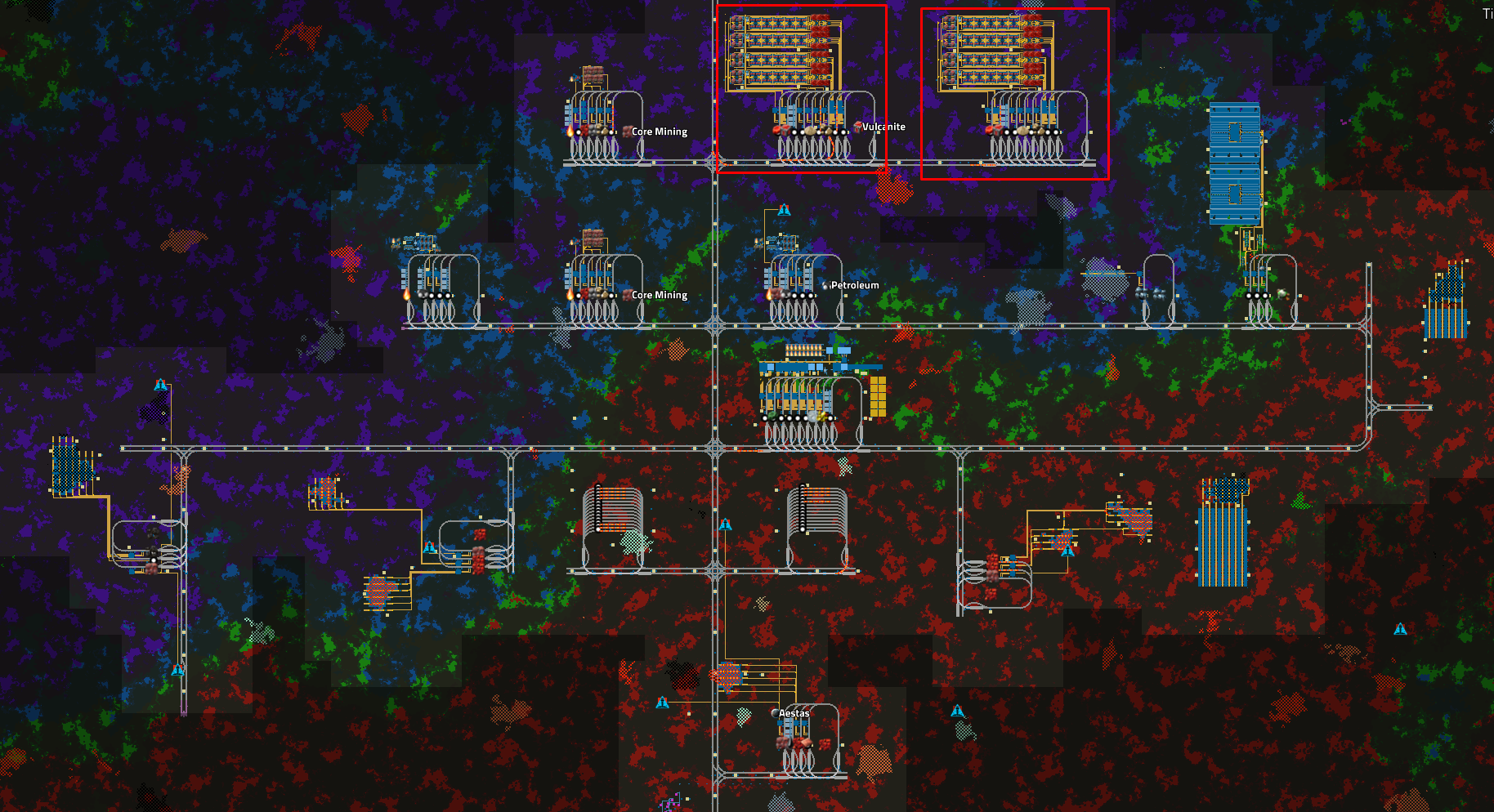
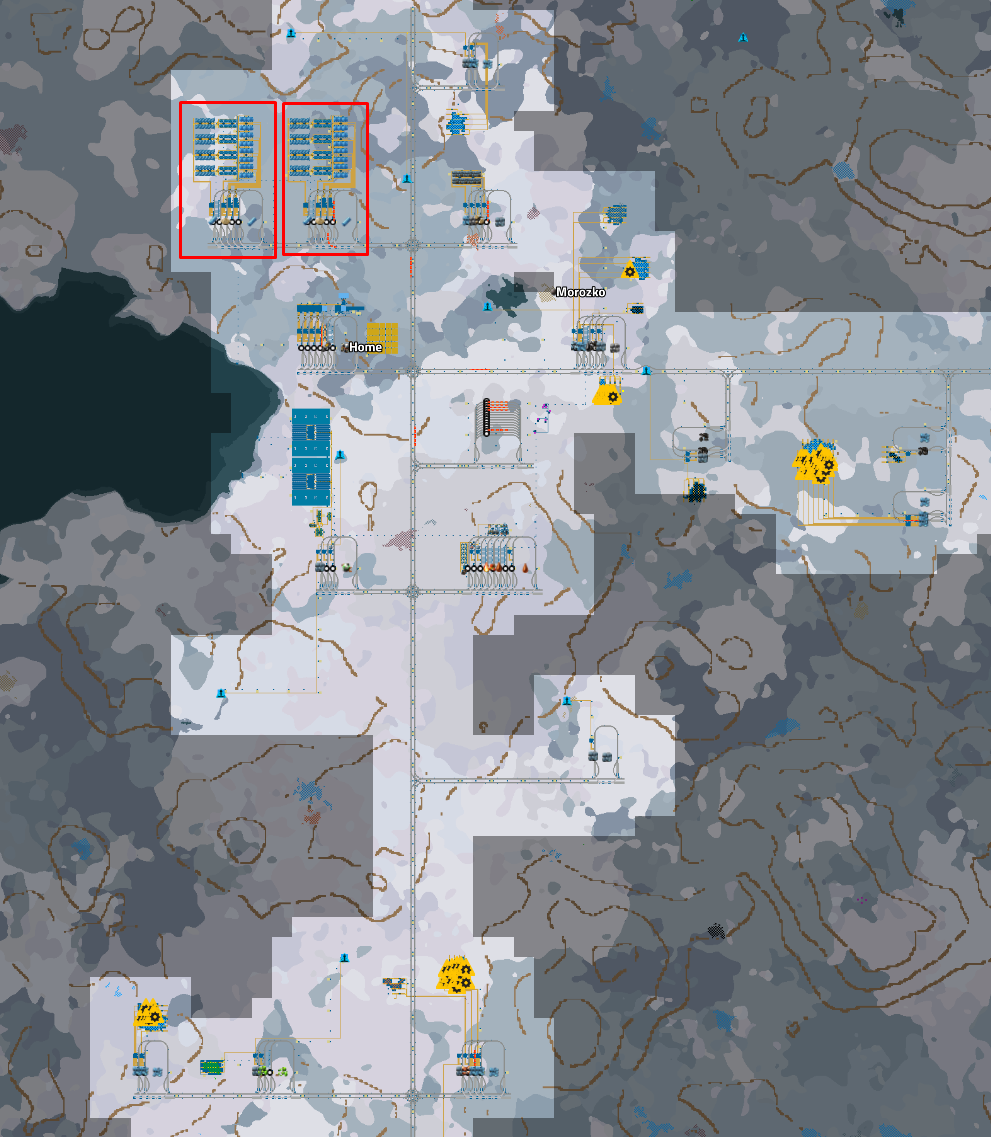
[95:38h] After all these new expansions, it's time to fix my base. First off, like I mentioned in the beryllium planet, I need to expand vulcanite and cryonite production to keep up with the demand. I didn't do anything fancy, I just duplicated the designs I had set up in Aestas and Morozko, going from 8600 to 17200 vulcanite/min and from 2580 to 5160 cryonite/min. To make up for it, I've also added speed modules in all the mines and expanded to a couple more.
[95:47h] The obvious consequence of this is that I now have a massive shortage of speed modules. So I've taken some time to expand those. I still have two rows for tier 1s in the middle with one row for tier 2 and tier 3 to the side, but now I use tier 3 assemblers and blue belts, and I've also added more belts for all the inputs



 1